Applying for Singapore PR is a fully online process, but a successful application is about far more than filling a form. It depends on applying under the right scheme, at the right time, with a complete file that presents your contribution and commitment clearly. This complete 2026 guide takes you through everything: why PR is worth it, who qualifies, the documents, the step-by-step process, fees, timelines, what ICA weighs, and what to do if you are rejected.
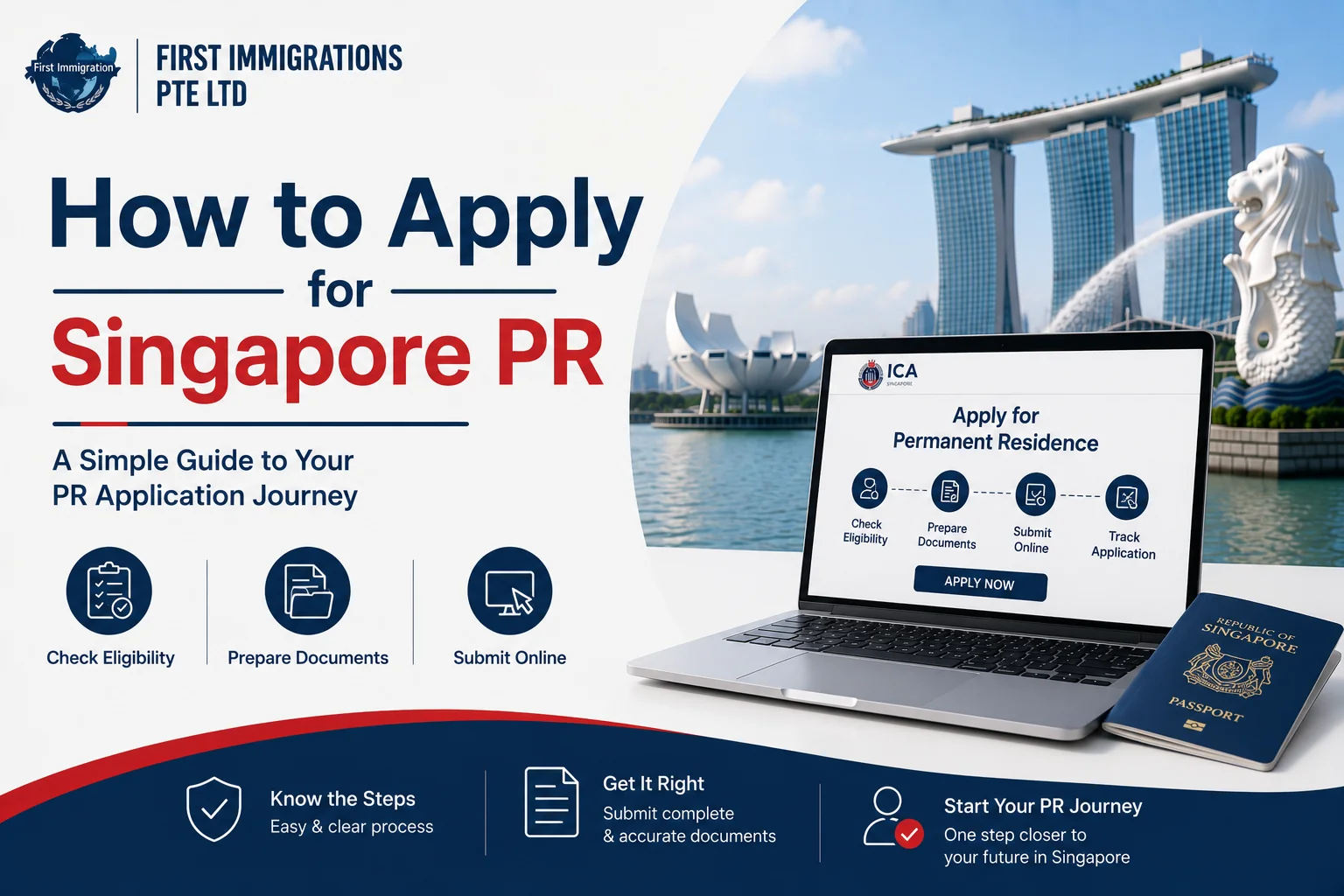
Quick answer: Confirm your scheme (most apply under the PTS scheme as an EP or S Pass holder), prepare your documents, then apply online through the ICA e-PR portal with Singpass. Complete the form, upload everything within the 7-day window, pay the S$100 fee per applicant, and submit. Processing takes around six months (often six to twelve). If approved, complete a medical and the formalities and collect your PR documents. There is no interview, and no published points formula.

Why become a Singapore PR?
Before the how, the why. PR turns a temporary work-pass stay into a settled life, with benefits a pass holder does not get:
- Career freedom. Work and change jobs without a pass, with no levy or quota attached to you.
- CPF savings. Build retirement, housing, and healthcare savings with employer contributions.
- Housing. Buy a resale HDB flat (after three years) and pay far lower property stamp duty than a foreigner.
- Healthcare and education. Subsidised care and lower school fees for your children.
- A path to citizenship. PR is the step before becoming a Singaporean.
For the full list, see our guide on Singapore PR benefits.
The 2026 landscape: what to expect
Two things shape your odds in 2026:
- A higher intake. Singapore has signalled it will raise PR grants toward about 40,000 a year (up from roughly 35,000). More places can modestly help strong profiles, but the bar is not lowered.
- Holistic, competitive assessment. ICA does not publish an approval rate or a points formula. It assesses each case as a whole, and only a minority of applications succeed. See our guide on the Singapore PR approval rate.
The takeaway: preparation and timing decide your outcome far more than the headline intake.
Step 1: Confirm which scheme you apply under
PR is assessed under separate schemes. Apply through the one that fits you.
| Scheme | Who it is for | Sponsor needed? |
| PTS (Professional, Technical and Skilled Workers) | EP, S Pass, PEP, or EntrePass holders working in Singapore | No |
| Family Ties | Spouse, unmarried child under 21, or aged parent of a citizen or PR | Yes |
| Foreign Student | Studied in Singapore 2+ years and passed a national exam (PSLE, GCE, or IB) | No |
| Global Investor Programme (GIP) | High-net-worth investors (from S$10 million) | Programme-based |
| Foreign Artistic Talent (ForArts) | Established artists with a record of contribution | No |
The PTS scheme is by far the most common route. For detail, see who is eligible to apply for PR.
Eligibility by applicant type
What ICA weighs, and what strengthens each profile, differs by who you are.
| Applicant type | Key factors | What strengthens it |
| Employment Pass holders | Salary, industry, stability, tax | Competitive sector salary, in-demand industry, employer continuity |
| Entrepreneurs / business owners | Business performance, local hiring, economic value | Revenue growth, CPF-paying local staff, innovation sectors |
| Investors (GIP) | Investment size, business track record | S$10m+ investment, strong operating history |
| Spouses of citizens / PRs | Marriage stability, integration, residence | Long co-residence, children in local schools, community ties |
| Foreign students | Academic record, length of stay, integration | National exam passes, strong grades, community involvement |
Should you apply now, or wait?
Timing is one of the biggest levers you control. Consider waiting if you:
- Started your Singapore job very recently, or are on probation.
- Earn below the median for your sector and age.
- Have a thin tax record (less than a year or two).
- Have changed employers frequently.
- Have spent long stretches overseas.
If several apply, a short wait to build a steadier profile beats a rushed application. See our guides on the best time to apply and whether switching jobs affects your chances.
Step 2: Prepare your documents
Get your full set ready before you start, because once you begin you have only seven days to upload everything.
Core documents:
- Passport biodata page (and previous passports).
- NRIC or FIN, and your current work pass.
- Employer letter dated within 3 months (job title, start date, salary).
- Last six months of payslips.
- Educational certificates and transcripts.
- Birth certificate; marriage certificate and children’s birth certificates if applying with family.
- Self-employed: ACRA business profile and recent financial statements.
Avoid these common document mistakes:
- Blurry, cropped, or low-resolution scans.
- Spelling inconsistencies between documents and the form.
- Missing official seals, stamps, or signatures.
- Non-English documents without a notarised English translation.
2026 update: ICA now draws on MOM, IRAS, and ACRA data directly, so the Annex A form and IRAS Notices of Assessment are generally no longer required. Keep tax records handy and check the current ICA checklist. See our full PR documents checklist.
Step 3: Apply online through ICA
All PR applications go through the ICA e-PR portal.
| Step | What you do |
| Get Singpass ready | You log in with Singpass; allow a few working days if new |
| Log in to the e-PR portal | Access ICA’s e-Service, or via MyICA |
| Complete the form | Fill every section: personal, family, education, employment |
| Upload documents and photo | Clear colour PDFs, within the 7-day window |
| Pay the fee | S$100 per applicant, non-refundable |
| Submit and save your reference | Keep the acknowledgement and reference number |
For family routes, the citizen or PR sponsor logs in with their Singpass to start it. See our step-by-step guides on the online PR application and filling the form in MyICA.
Fees
| Fee | Amount | When |
| Application (processing) | S$100 per applicant | At submission (non-refundable) |
| Entry Permit | Around S$20 | On approval |
| Re-Entry Permit (5-year) | Around S$50 | On approval |
| Singapore identity card | Around S$50 | On approval |
Fees are current 2026 amounts and can change. Confirm with ICA.

Step 4: Wait for processing (and use the time well)
ICA aims to process applications within about six months, though six to twelve is common, and complex cases longer. There are no progress updates, and refreshing the status page changes nothing. See our guide on PR processing time.
Make the wait productive. Rather than watching the portal, use the months to strengthen your standing in case you need to reapply:
- Take a course or gain a qualification.
- Volunteer or join grassroots or community activities.
- Seek a promotion or salary increase.
- Keep your tax and CPF records clean.
Track your status by logging back in with Singpass. Our guide on checking your PR application status explains each result.
What ICA really evaluates
PR is judged holistically. Based on observed outcomes, ICA weighs:
- Economic contribution: salary, progression, tax paid, and how relevant your sector is.
- Length and stability of your stay and employment.
- Qualifications and skills, especially in-demand ones.
- Family ties to Singaporeans or PRs.
- Genuine integration into the community.
- Age and long-term potential.
No single factor decides it, and meeting the minimums does not guarantee approval. See what ICA really evaluates and the factors that affect your chances.
Step 5: After approval, complete the formalities
If approved, you receive an approval (In-Principle Approval) letter, valid for a limited period. Within that window:
- Read and verify the letter and its deadline. See checking your IPA status.
- Complete the medical examination if required.
- Book your ICA appointment and pay the remaining fees.
- Collect your documents: the Entry Permit confirming PR, your Re-Entry Permit, and your blue NRIC (from age 15).
If your application is unsuccessful
ICA does not disclose reasons for a rejection. Common causes are below-benchmark income, too little time in Singapore, an unstable employment history, incomplete documents, or weak integration. You have two routes:
- Appeal within six months, if you have new, substantive information.
- Reapply later, usually after 12 to 24 months, with a stronger profile.
See our guides on what to do after a PR rejection and appeal vs reapply.
How to maintain your PR
PR is not entirely unconditional. To keep it and travel, you hold a valid Re-Entry Permit (REP), usually up to five years, renewed before it expires. If your REP lapses while you are overseas, you can lose your PR. See our guide on Re-Entry Permit renewal.
The next step: citizenship
For many, PR is a stepping stone to citizenship. You generally need to have held PR for at least two years before applying, and becoming a citizen means renouncing your other nationality. Our comparison of PR vs citizen and guide to citizenship requirements map out that step.
How First Immigration can help
The portal is the easy part; a competitive application is the hard part. First Immigration helps you:
- Confirm your scheme and whether you are ready to apply.
- Prepare a complete, well-organised document set.
- Present your profile the way ICA assesses most favourably.
- Handle the process end to end, including Employment Pass to PR and self-employed cases.
For more on strengthening your case, see our PR application tips, or speak to our consultants through the contact page.

Frequently asked questions
How do I apply for Singapore PR?
Confirm your scheme (usually PTS as an EP or S Pass holder), prepare your documents, then apply online through the ICA e-PR portal with Singpass. Complete the form, upload files within the 7-day window, pay the S$100 fee, and submit.
Who can apply for Singapore PR?
EP, S Pass, PEP, or EntrePass holders (PTS scheme); spouses, children, and aged parents of citizens or PRs (Family Ties); eligible foreign students; Global Investor Programme investors; and established artists under ForArts.
How long should I work in Singapore before applying?
Most successful PTS applicants apply after two to three years of continuous employment, which shows stable income and genuine commitment.
Is there a minimum salary to apply for PR?
There is no fixed PR salary cut-off, but EP holders should meet the qualifying salary (currently from S$5,600, or S$6,200 in financial services, rising in January 2027). Salary is weighed alongside your whole profile.
How much does it cost to apply for PR?
S$100 per applicant at submission. On approval, further fees apply, currently around S$20 for the Entry Permit, S$50 for a 5-year Re-Entry Permit, and S$50 for the identity card.
How long does a Singapore PR application take?
Usually around six months when documents are complete, though complex cases can take longer. ICA does not give progress updates.
Do I need a Singpass to apply?
Yes. The e-PR system requires Singpass. If you are not eligible for one, ICA issues unique login credentials. For family schemes, the sponsor logs in.
What happens after my PR is approved?
You receive an approval letter, complete a medical if required, book an ICA appointment, pay the remaining fees, and collect your Entry Permit, Re-Entry Permit, and blue NRIC.
How do I keep my PR status?
Hold a valid Re-Entry Permit (usually up to five years) and renew it before it expires, especially before travelling overseas.
What if my PR application is rejected?
You can appeal within six months or reapply later with a stronger profile. Our rejection guide explains both routes.