Becoming a Singapore Permanent Resident changes your standing in real, measurable ways: cheaper property stamp duty, CPF savings, subsidised healthcare and schooling, and the freedom to work without a pass. This guide sets out the benefits of Singapore PR in 2026, with the concrete numbers, plus the trade-offs worth knowing before you commit.
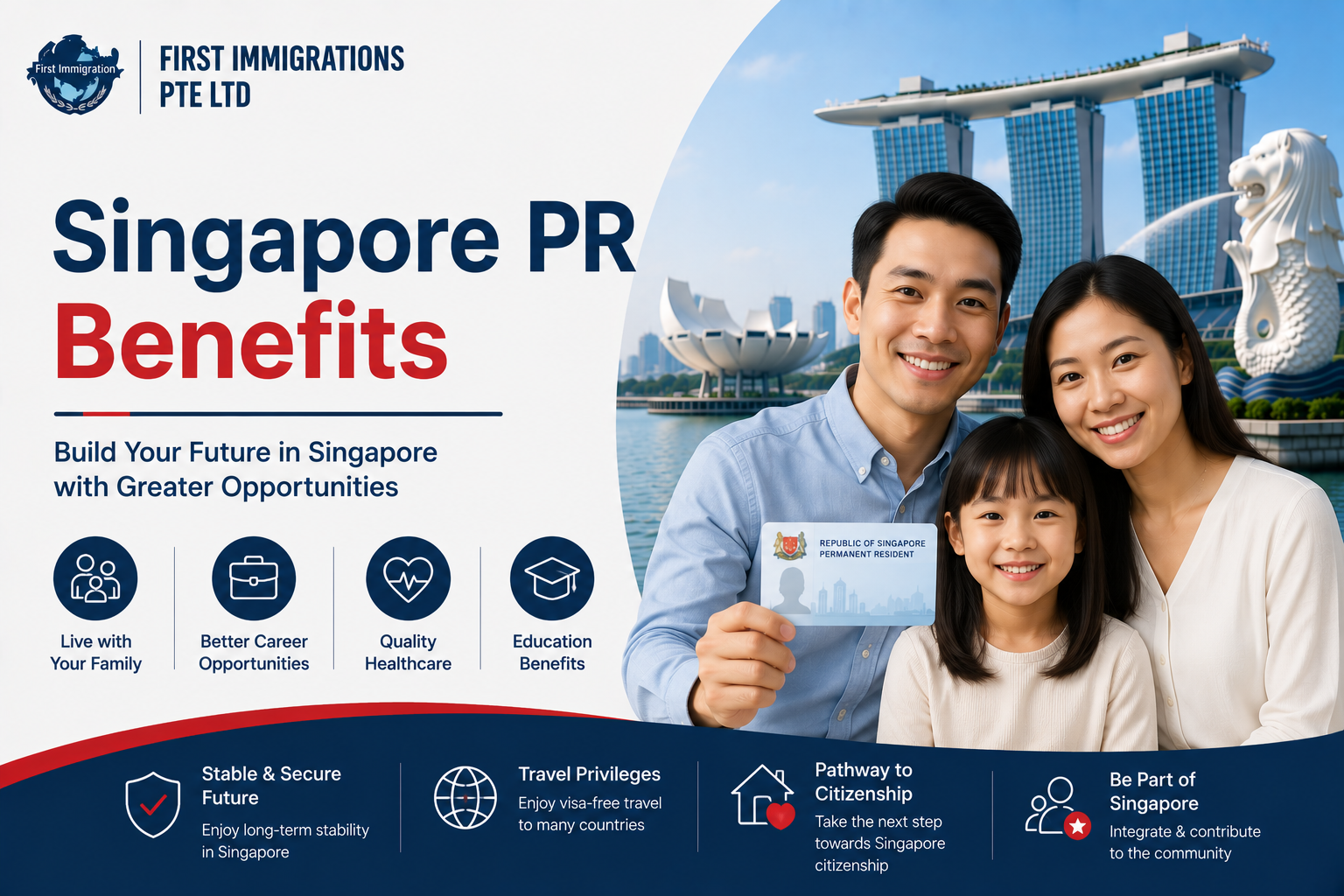
Quick answer: The biggest PR benefits are employment freedom (no work pass, no levy, no quota), CPF savings with employer contributions, the right to buy a resale HDB flat, far lower property stamp duty than foreigners (5% vs 60% on a first home), subsidised healthcare and national insurance, cheaper schooling for your children, family sponsorship, and a pathway to citizenship after two years. PR is not unconditional, so the main trade-offs are keeping a valid Re-Entry Permit and, for some, National Service for second-generation sons.
PR vs foreigner: the benefits at a glance
The clearest way to see PR’s value is against a work-pass holder or foreigner.
| Area | Foreigner / work-pass holder | Singapore PR |
| Right to work | Tied to a specific employer and pass | No pass needed; change jobs freely, no levy |
| CPF | None | Enrolled, with employer contributions |
| HDB resale flat | Not eligible | Eligible after 3 years of PR, when buying as a family |
| Stamp duty (ABSD) on first home | 60% | 5% |
| Healthcare | Unsubsidised or limited | Government subsidies plus MediShield Life |
| Children’s school fees | International-student rates | Much lower PR rates |
| Family | Limited | Can sponsor spouse and children for PR |
| Citizenship | Not available | Eligible to apply after 2 years |
The rest of this guide breaks these down.

1. Employment freedom
This is the benefit people feel first. A PR does not need a work pass. You can change employers without applying for a new pass, and you are not counted against an employer’s foreign-worker quota or levy. That makes you cheaper and simpler to hire than a pass holder, which widens your job options and strengthens your bargaining position.
2. CPF savings
As a PR you join the Central Provident Fund, Singapore’s mandatory savings scheme, and your employer contributes alongside you. Contributions are split across three accounts:
- Ordinary Account for housing and investment.
- Special Account for retirement.
- MediSave Account for healthcare.
Rates are phased in. In your first two years of PR they are on a lower, graduated scale, then from the third year you move to the full rates (for those under 55, employer around 17% and employee around 20%). Over time this builds a substantial housing and retirement fund you would not have as a foreigner.
3. Housing and property
Housing is where PR saves the most money.
- Resale HDB flats. PRs who have held PR for at least three years can buy a resale HDB flat as a family nucleus, for example with a spouse and children. Single PRs cannot buy an HDB flat on their own, and non-Malaysian PR households must also fit within the block’s and neighbourhood’s PR quota. New BTO flats still require a citizen in the household. Check your eligibility with HDB before you start house-hunting.
- Lower stamp duty. On a first residential property a PR pays 5% ABSD, against 60% for a foreigner. (A citizen pays 0%.) The gap is large enough to change what you can afford.
- CPF for property. You can use your CPF Ordinary Account toward an HDB resale flat or private property.
- Better financing. PRs generally access better loan terms and higher loan-to-value ratios than foreigners.
| ABSD rate | 1st residential property | 2nd property | 3rd and subsequent |
| Singapore Citizen | 0% | 20% | 30% |
| Singapore PR | 5% | 30% | 35% |
| Foreigner | 60% | 60% | 60% |
Rates from IRAS, in effect since 27 April 2023. Check the IRAS website for the latest rates before you buy.
4. Healthcare
PRs get subsidised care at public hospitals and polyclinics, well below what foreigners pay, and join the national insurance schemes: MediShield Life for large hospital bills and CareShield Life for long-term care. Your MediSave account helps cover premiums and approved expenses. Subsidies are lower than a citizen’s, but far better than a foreigner’s.
5. Education for your children
PR children attend government and government-aided schools at PR fees, roughly S$330 to S$760 a month in 2026 depending on level. That is much less than international-student rates, and PR children rank ahead of international students (though behind citizens) in school admissions.
| Level (government schools) | PR monthly school fees in 2026 |
| Primary | S$330 |
| Secondary | S$680 |
| Pre-university | S$760 |
Source: Ministry of Education. Miscellaneous fees are charged separately.
6. Family sponsorship
As a PR you can sponsor close family. Your spouse and unmarried children under 21 can apply for PR through the family route, and parents may be able to stay on a Long-Term Visit Pass. It lets you keep the household together rather than juggling separate passes.
7. Travel and long-term stability
PR is indefinite. Unlike a work pass that expires or is tied to a job, PR lets you settle for the long term. To travel in and out and keep your status, you hold a Re-Entry Permit (usually valid up to five years), renewed before it expires.

8. Starting a business
A PR can incorporate and own a company in Singapore directly and hold equity without the restrictions foreigners face, which makes PR attractive for entrepreneurs. If you run your own company, see our guide on applying for PR as a self-employed EP holder.
9. A pathway to citizenship
PR is the step before citizenship. Once you have held PR for at least two years (and are over 21), you can apply to become a citizen, which adds the vote, the strongest subsidies, and a Singapore passport. For the full comparison, see our guide on Singapore PR vs citizen.
Singapore PR vs Singapore citizen
PR gives you most of the practical benefits of living in Singapore. Citizenship goes further, but asks more of you in return.
| Area | Singapore PR | Singapore citizen |
| Passport | Keep your existing passport | Singapore passport; Singapore does not allow dual citizenship |
| Voting | Cannot vote | Can vote |
| Leaving and re-entering Singapore | Needs a valid Re-Entry Permit | No permit needed |
| HDB flats | Resale flats only, after 3 years of PR, as a family | New BTO and resale flats |
| ABSD on first home | 5% | 0% |
| School fees (primary, 2026) | S$330 a month | Lowest rates, with priority in admissions |
| National Service | Second-generation male PRs are liable | Male citizens are liable |
If you are weighing the next step, see our guides on Singapore citizenship eligibility and how to become a Singapore citizen.
The trade-offs to know
PR is valuable, but it is not free of obligations. Go in with eyes open.
- PR can lapse. If your Re-Entry Permit expires while you are overseas, you can lose your status. It needs renewing.
- Stamp duty still applies. The 5% first-home ABSD is far below a foreigner’s, but it is not zero like a citizen’s, and it rises steeply on second and later properties.
- National Service. Second-generation male PRs (those granted PR as children or students) are liable for NS, the same as citizens.
- Citizenship means renouncing. If you later take citizenship, Singapore does not allow dual citizenship, so you must give up your other passport. See our guide on whether Singapore allows dual citizenship.
Your responsibilities as a PR
| Responsibility | What it means in practice |
| Keep a valid Re-Entry Permit | Renew it before it expires if you travel. Leaving Singapore without one, or letting it lapse while abroad, can cost you your PR status. |
| Contribute to CPF | You and your employer make mandatory CPF contributions, phased in over your first two years of PR. |
| National Service | Second-generation male PRs, such as sons granted PR as children or students, must serve National Service. |
| Show commitment to Singapore | PR is meant for people putting down roots. Your time living in Singapore and your ties here also count if you later apply for citizenship. |
Is Singapore PR worth it?
For most people planning to stay several years, yes. The housing stamp-duty saving alone can run into tens of thousands of dollars, and CPF, subsidised healthcare, cheaper schooling, and job freedom compound over time. PR suits you if you want to put down roots while keeping your original citizenship. If you are ready to commit fully and give up your other passport, citizenship is the next step.

Not sure if you qualify? Start with our guide to Singapore PR requirements, which explains who can apply and how ICA assesses applications, or book a free PR assessment.
How First Immigration can help
Enjoying these benefits starts with a successful application. First Immigration helps you:
- Assess whether you are ready to apply and under which scheme.
- Prepare a complete, competitive application.
- Plan the timing toward PR and, later, citizenship.
See our guides on how to apply for Singapore PR and PR application tips, or speak to our consultants through the contact page.
Frequently asked questions
What are the main benefits of Singapore PR?
Employment freedom without a work pass, CPF savings with employer contributions, the right to buy a resale HDB flat, much lower property stamp duty than foreigners, subsidised healthcare and national insurance, cheaper schooling for children, family sponsorship, and a pathway to citizenship.
How much stamp duty does a PR pay compared to a foreigner?
On a first residential property a PR pays 5% ABSD, against 60% for a foreigner. Citizens pay 0% on their first home.
Can a Singapore PR buy an HDB flat?
Yes, a resale flat, if you have held PR for at least three years and buy as a family nucleus (for example with your spouse and children). Single PRs cannot buy an HDB flat, and non-Malaysian PR households must fit within the PR quota. New BTO flats require at least one citizen.
Do PRs get CPF?
Yes. PRs join CPF with employer contributions. Rates are lower in the first two years and reach full rates from the third year.
Do PR children pay lower school fees?
Yes. PR children pay PR rates at government schools (roughly S$330 to S$760 a month in 2026), far less than international students, and rank ahead of them in admissions.
Do PRs get subsidised healthcare?
Yes. PRs receive government subsidies at public hospitals and polyclinics and join MediShield Life and CareShield Life, though at lower subsidy levels than citizens.
Can a PR sponsor family members?
Yes. A PR can sponsor a spouse and unmarried children under 21 for PR, and parents may qualify for a Long-Term Visit Pass.
When can a PR apply for citizenship?
Generally after holding PR for at least two years, if over 21. Becoming a citizen requires renouncing other citizenships.
What are the downsides of Singapore PR?
You must keep a valid Re-Entry Permit or risk losing status, stamp duty still applies (though far less than for foreigners), and second-generation male PRs are liable for National Service.