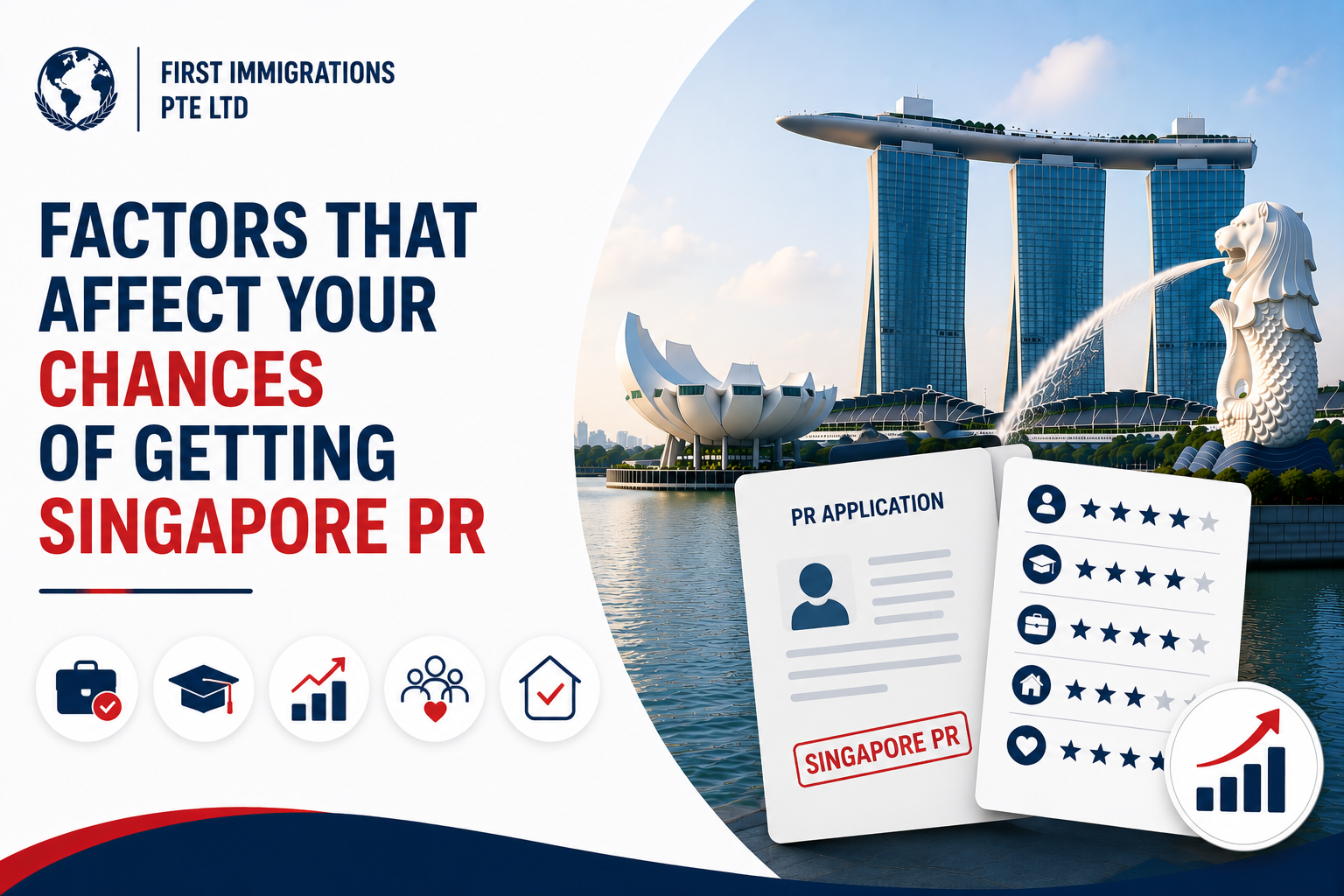
Singapore PR is competitive, and roughly one in three applications succeeds. But your personal odds are decided by your profile, not the average. This guide breaks down the factors that affect your chances of getting Singapore PR, and for each one, what helps and what hurts, so you know where you stand and what to work on.
Quick answer: ICA assesses PR holistically, weighing your economic contribution, length of stay, age, qualifications, family ties, integration, and long-term commitment together. No single factor decides it, and meeting the minimums does not guarantee approval. The strongest applications show a stable, progressing career, two to three years of genuine residence, and real roots in Singapore. The factors you most control are timing, salary progression, and documented integration.
How ICA decides (and why factors matter)
ICA does not publish a points formula. It looks at your whole profile and judges, at its discretion, whether granting you PR benefits Singapore long term. That is why two applicants with similar salaries can get different outcomes: it is the combination of factors that counts. For the numbers behind this, see our guide on the Singapore PR approval rate, and for how each factor is weighed, what ICA really evaluates.
The factors at a glance
| Factor | Helps your chances | Hurts your chances |
| Economic contribution | Rising salary, stable job, in-demand sector, steady tax | Flat or low salary, job-hopping, weak sector |
| Length of stay | 2 to 3+ years of continuous residence | Applying in year one |
| Age | 21 to 40, more working years ahead | Older with a weaker overall profile |
| Qualifications | Strong, relevant, in-demand skills | Unrecognised or misaligned qualifications |
| Family ties in Singapore | Spouse, children, or family who are citizens or PRs | No local family ties |
| Applying with family | A settled household applying together | A strong case undermined by a weak co-applicant |
| Integration | Documented community involvement over time | Tax-paying only, no sign of roots |
| Long-term commitment | Property, longer tenure, sinking roots | Signs you may not stay |
1. Economic contribution
This is the factor ICA weighs most. It looks at your salary, how it has grown, the stability of your employment, your sector, and the tax you pay.
- Helps: a salary that is strong for your role and age, clear progression year on year, a reputable employer, an in-demand sector (tech, finance, healthcare), and a consistent tax record.
- Hurts: a flat salary held for years, frequent job changes, a weak or declining sector, or gaps in employment.
A rising income beats a high but static one. If your salary has stalled, that is worth addressing before you apply.
2. Length of stay and work history
Time in Singapore signals commitment and gives ICA a track record to assess.
- Helps: two to three years or more of continuous, stable work and residence.
- Hurts: applying within a year of arriving, or a patchy history with long gaps or time spent mostly overseas.
Most successful applicants apply after two to three years. For timing, see our guide on the best time to apply for PR.
3. Age
Age is read for what it says about your future contribution.
- Helps: being in the 21 to 40 range, where you have many working years ahead. This group makes up the majority of new PRs.
- Hurts: being older with a profile that does not otherwise stand out. Older applicants can still succeed, but usually need a stronger overall case.
4. Qualifications and skills
Your credentials speak to your long-term value.
- Helps: a recognised degree, professional certifications, and skills Singapore is short of.
- Hurts: qualifications from unrecognised institutions, or skills poorly matched to your role and salary.
Upskilling in an in-demand area can strengthen a borderline profile.
5. Existing family ties in Singapore
Roots through family suggest deeper, more permanent ties.
- Helps: a spouse, children, parents, or siblings who are Singapore citizens or PRs.
- Hurts: no local family ties. This is rarely fatal on its own, but it means the rest of your profile has to carry more weight.
6. Applying with family
Whether you apply alone or together can shape the picture.
- Helps: applying as a settled household with a spouse and children signals a life anchored in Singapore.
- Hurts: a weak co-applicant can dilute an otherwise strong case, so the timing and strength of a joint application matter.
7. Integration into society
ICA wants to see you are part of the community, not just resident in it.
- Helps: sustained, documented involvement, volunteering, grassroots or community groups, children in local schools, over time.
- Hurts: paying tax but showing no sign of integration, which reads as transactional.
Integration judged over years beats a one-off gesture. Keep records (letters, photos, roles).
8. Long-term commitment
Everything above rolls up into one question: are you here to stay?
- Helps: signals of permanence like property ownership, a longer tenure, and deep local ties.
- Hurts: anything suggesting you may leave, such as keeping most of your life and assets abroad.
What you can control, and what you cannot
Some factors are fixed in the short term (age, existing family ties). Others are firmly in your hands:
- Timing your application after two to three years, and after a raise or promotion.
- Salary progression, by pushing for advancement before you apply.
- Integration, by building and documenting community involvement.
- Documents, by presenting a complete, consistent, well-organised file.
Focus your energy on these. Our PR application tips show how, and our guide on PR eligibility helps you judge if you are ready.
How First Immigration can help
Because the factors combine in ways ICA never explains, an honest read on where you stand is worth a lot. First Immigration helps you:
- Assess your profile factor by factor, and your realistic chances.
- Identify the weak spots to fix before you apply.
- Time your application for the strongest possible case.
- Present your profile the way ICA weighs it.
Whether you are moving from Employment Pass to PR or applying with family, speak to our consultants through the contact page.
Frequently asked questions
What factors affect my chances of getting Singapore PR?
Your economic contribution, length of stay, age, qualifications, family ties in Singapore, whether you apply with family, integration, and long-term commitment, all weighed together by ICA.
Which factor matters most for PR?
Economic contribution (salary, progression, stability, and tax) carries the most weight, but it is assessed alongside everything else, not on its own.
Does salary decide my PR chances?
Salary is important, and higher earners fare better, but a rising, stable income within a strong overall profile matters more than a single high figure.
How long should I be in Singapore before applying?
Most successful applicants apply after two to three years of stable work and residence. Applying in your first year rarely works.
Does age affect PR chances?
Yes. Applicants aged 21 to 40 make up the majority of new PRs. Older applicants can still succeed but usually need a stronger overall profile.
Do I need family in Singapore to get PR?
No, but existing family ties to citizens or PRs help. Without them, the rest of your profile needs to be stronger.
How important is integration?
Very. Genuine, documented community involvement over time is a decisive factor, especially for borderline profiles.
Which factors can I actually change?
Timing, salary progression, integration, and how well you present your documents. Focus on these, since age and existing family ties are fixed in the short term.