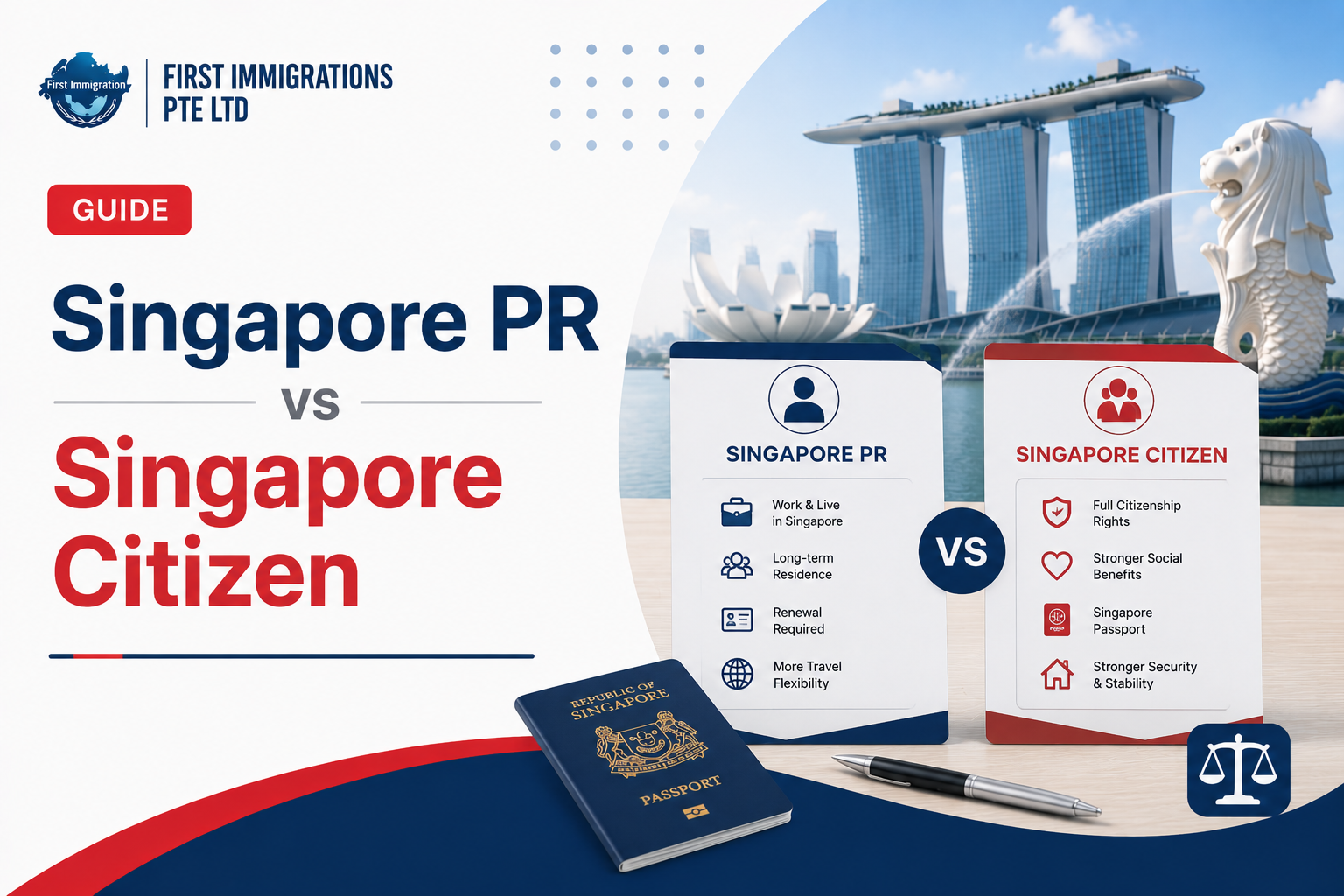
Permanent Residence and citizenship both let you settle in Singapore for good, but they are not the same thing. The gaps show up where it matters most: housing grants, school fees, healthcare subsidies, voting, National Service, and whether you keep your original passport. This guide compares Singapore PR vs Singapore citizen side by side, then explains what each difference means in practice.
Quick answer: A Singapore citizen has the fullest set of rights: a Singapore passport, the vote, the best housing, healthcare, and education subsidies, and no need to renounce nothing (citizens hold only Singapore nationality). A Permanent Resident gets most residence and work rights and can keep their original citizenship, but pays more for housing, schooling, and healthcare, cannot vote, and must renew a Re-Entry Permit to keep PR status. The main trade-off: citizenship means giving up your other passport; PR lets you keep it.
At a glance: PR vs citizen
| Area | Permanent Resident (PR) | Singapore Citizen |
| Legal status | Indefinite, but tied to a Re-Entry Permit (REP) that must be renewed | Unconditional and permanent |
| Passport | Keeps foreign passport; needs a valid REP to re-enter | Singapore passport, strong visa-free access |
| Dual citizenship | Keeps original citizenship | Must renounce all other citizenships |
| Voting | Cannot vote | Can vote and stand in elections |
| New HDB (BTO) flat | Not eligible on their own | Eligible, with grants |
| Resale HDB flat | Allowed after a 3-year wait; no CPF housing grants | Allowed, with CPF housing grants |
| Property stamp duty (ABSD) | 5% on first home | 0% on first home |
| CPF rates | Graduated (lower) in first 2 years, then same as citizens | Full rates |
| Healthcare subsidies | Lower; about half the MediShield Life premium subsidy | Highest, plus CHAS |
| School fees (govt schools) | Higher monthly fees than citizens | Free or minimal fees |
| National Service | Applies to second-generation male PRs | Compulsory for all male citizens |
| Can lose status | Yes, if REP lapses or is not renewed | No |
Rates and figures reflect current 2026 policy and can change. Always check the latest official position before making a decision.
What is Singapore Permanent Residence?
PR lets you live, work, and settle in Singapore indefinitely without a work pass. You can change jobs freely, sponsor certain family members, and buy resale property. The catch is that PR is not unconditional: to travel in and out and keep your status, you hold a valid Re-Entry Permit, usually renewed every five years. Let it lapse while overseas and you can lose your PR.
You also keep your original citizenship as a PR, which is why many people settle at this stage. For the fuller list, see the benefits of Singapore PR.
What is Singapore citizenship?
Citizenship is full, unconditional membership. You get a Singapore passport, the right to vote, the strongest subsidies across housing, healthcare, and education, and status that cannot lapse. The trade-off is firm: Singapore does not allow dual citizenship for adults, so you must renounce every other nationality to become a citizen. We cover that in detail in does Singapore allow dual citizenship.
The differences that matter, explained
Immigration status and security
A citizen’s status is permanent and unconditional. A PR’s status depends on the Re-Entry Permit; if it expires while you are abroad, your PR can be lost. In practice PR is very stable, but it is not the absolute security that citizenship gives.
Passport and travel
Citizens travel on the Singapore passport, one of the strongest in the world for visa-free access, and never need a re-entry permit. PRs keep their home-country passport and must hold a valid REP to leave and return without losing status.
Keeping your original citizenship
This is often the deciding factor. A PR keeps their original nationality. A citizen must give theirs up, and re-acquiring a renounced Singapore or foreign citizenship later is very hard. If keeping your current passport matters, PR is the natural home.
Housing
Housing is where the money difference is largest.
- New HDB (BTO) flats: reserved for households with at least one citizen. Two PRs cannot buy a BTO together.
- Resale HDB flats: a PR household can buy on the open market, but only after holding PR for three years, and without the CPF housing grants citizens receive.
- Grants: schemes such as the Enhanced CPF Housing Grant go to citizen households, not PR-only households.
- Additional Buyer’s Stamp Duty (ABSD): PRs pay more from the first property.
| Property (current ABSD) | Permanent Resident | Singapore Citizen |
| First residential property | 5% | 0% |
| Second property | 30% | 20% |
| Third and subsequent | 35% | 30% |
CPF (Central Provident Fund)
Once you have held PR for more than two years, CPF contribution rates match a citizen’s. In the first two years of PR, the employee contribution is on a lower, graduated scale (the employer’s stays higher), which slightly reduces take-home CPF savings early on.
Healthcare and subsidies
Both PRs and citizens get subsidised care at public clinics and hospitals, but citizens get more. Citizens receive the highest subsidies plus CHAS support at GP and dental clinics. PRs get lower subsidy tiers and roughly half the MediShield Life premium subsidy a citizen receives.
Education
Citizens pay little or nothing in government schools. PR children pay monthly fees that are higher than citizens but far below international-student rates. For 2026, PR fees run around S$330 a month at primary level and S$680 a month at secondary level, and citizens also get first priority in school admissions.
Voting and civic rights
Only citizens can vote in national elections or stand for office. PRs, however settled, have no vote.
National Service
NS is compulsory for all male citizens. For PRs it depends on how PR was obtained: first-generation PRs (who got it as adults) generally do not serve, but second-generation male PRs (those granted PR as children or students) must register for and complete NS, just like citizens. For families with sons, this is an important planning point.
Can PRs become citizens?
Yes, and it is the usual path. You generally need to have held PR for at least two years before applying for citizenship, and ICA assesses the same broad factors it uses for PR: family ties, economic contribution, qualifications, age, and how well you have settled in. The one hard condition on approval is renouncing your other citizenship.
If you are still working toward PR, our guides on applying for Singapore PR and moving from Employment Pass to PR set out the steps.
Which is better for you?
There is no single right answer. It depends on what you want and what you are willing to give up.
PR may suit you if:
- You want to keep your original citizenship and passport.
- You want to live and work in Singapore long term without full commitment yet.
- You are comfortable renewing a Re-Entry Permit and paying somewhat more for housing and schooling.
Citizenship may suit you if:
- Singapore is your permanent home and you are ready to give up your other passport.
- You want the vote, the strongest subsidies, and BTO eligibility.
- You want status that never lapses and the best terms for your children’s education.
For most people the sensible route is PR first, then citizenship once you are certain Singapore is home and you are ready to renounce your other nationality.
How First Immigration can help
Choosing between PR and citizenship is really a decision about your family’s next decade: your finances, your children’s schooling, your passport, and, for sons, National Service. First Immigration helps you:
- Compare the two against your actual situation, not a generic checklist.
- Plan the timing of a PR or citizenship application.
- Understand the renunciation and NS implications before you commit.
Explore our Singapore citizenship service, or speak to our consultants through the contact page.
Frequently asked questions
What is the main difference between a Singapore PR and a citizen?
A citizen has full, unconditional rights including a Singapore passport, the vote, and the best subsidies, but must hold only Singapore nationality. A PR keeps their original citizenship and most residence rights, but cannot vote, pays more for housing and schooling, and must renew a Re-Entry Permit.
Can a Singapore PR vote?
No. Voting is reserved for citizens.
Can a PR buy an HDB flat?
A PR household can buy a resale HDB flat after holding PR for three years, but cannot buy a new BTO flat (that needs at least one citizen) and does not receive CPF housing grants.
Do PRs pay more stamp duty than citizens?
Yes. Under current ABSD rates, PRs pay 5% on their first residential property while citizens pay 0%, and PRs pay more on second and subsequent properties too.
Do PRs have to do National Service?
First-generation PRs generally do not, but second-generation male PRs (granted PR as children or students) must serve NS, the same as male citizens.
Is CPF the same for PRs and citizens?
After two years of PR, yes. During the first two years of PR, the employee contribution is on a lower graduated rate.
Do PR children pay school fees?
Yes. In government schools, PR children pay monthly fees (around S$330 primary and S$680 secondary for 2026), higher than citizens but far lower than international students.
Can a PR keep their original citizenship?
Yes. PR status does not require renouncing your citizenship. Only becoming a Singapore citizen requires giving up your other nationality.
How do I go from PR to citizenship?
You generally need at least two years as a PR, then apply through ICA. If approved, you must renounce your other citizenship before becoming a Singaporean.
Which is better, PR or citizenship?
PR suits those who want to keep their original passport and settle long term; citizenship suits those ready to make Singapore their permanent home for the vote, top subsidies, and unconditional status. Most people take PR first, then citizenship later.