Applying for Singapore PR comes with one big unknown: how long the wait will be. ICA aims to process applications within about six months, but in practice many applicants wait longer. This guide sets out the realistic timeline, the stages your application moves through, what slows it down, and how to avoid adding delay yourself.
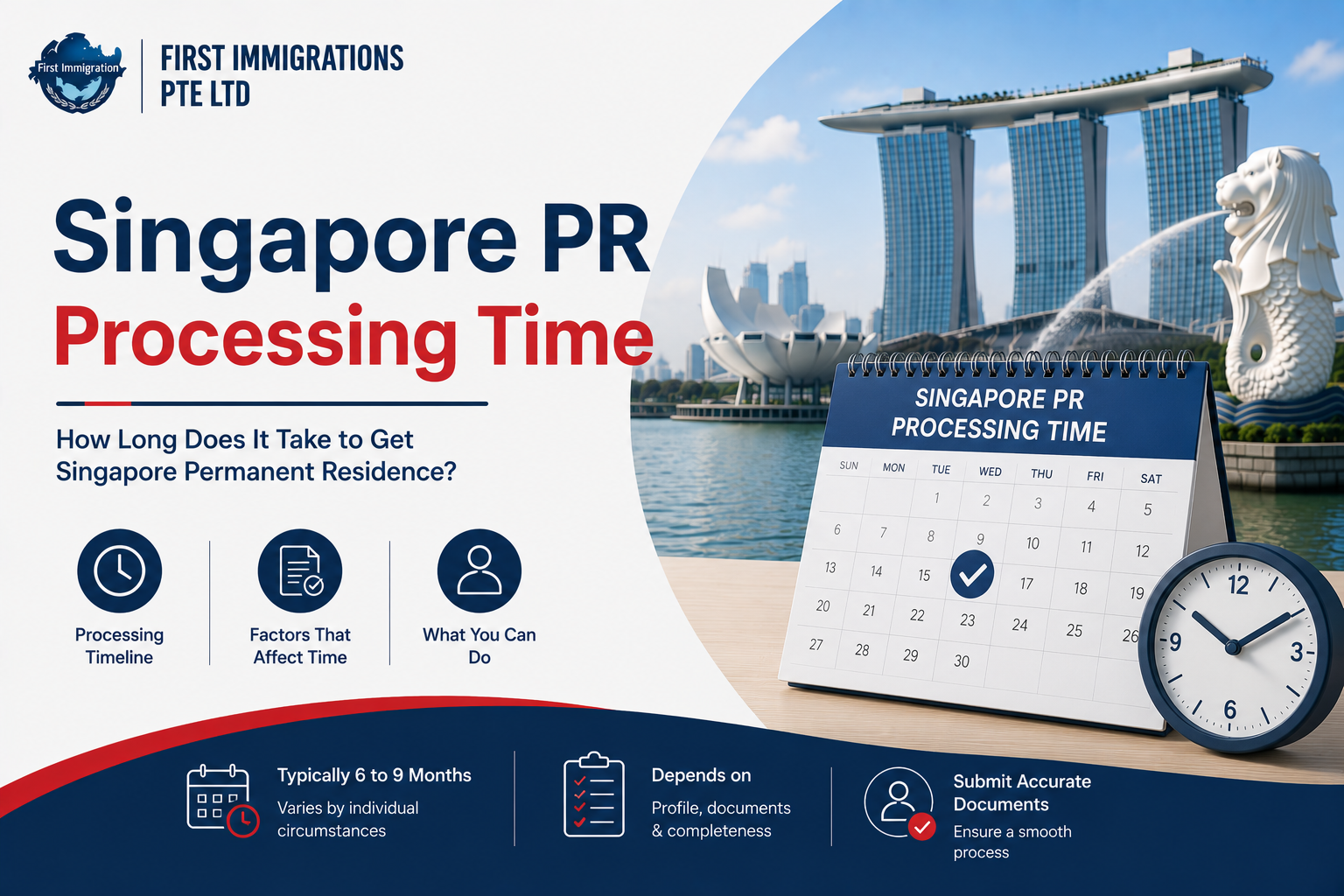
Quick answer: ICA officially processes PR applications within about six months when documents are complete and in order. In practice, plan for six to twelve months. Straightforward, well-documented cases can finish in four to six months, while complex ones (multiple dependants, self-employment, unusual employment history, or extra checks) can stretch to twelve months or more. A higher PR intake in 2026 is not expected to speed things up.
Official vs realistic timeline
The number ICA publishes and the number applicants actually experience are not always the same.
| Scenario | Typical processing time |
| ICA’s official guidance | Within about 6 months, if documents are complete |
| Straightforward, complete application | 4 to 6 months |
| Typical real-world wait | 6 to 12 months |
| Complex cases (dependants, self-employed, extra checks) | 9 to 18 months |
The takeaway: treat six months as a best case, not a promise. Building in a longer window saves a lot of anxiety.
The PR application timeline, stage by stage
Once you submit through the ICA e-PR portal, your application moves through these stages.
| Stage | What happens | Rough timing |
| 1. Acknowledgement | You get an email confirming submission and a reference number | Immediately |
| 2. Assessment | ICA reviews your economic contribution, integration, and long-term commitment | The bulk of the wait |
| 3. Clarification (if any) | ICA may request extra documents through the portal; respond promptly | Varies |
| 4. Decision | You receive the outcome; if approved, an approval (In-Principle) letter | After assessment |
| 5. Formalities | Medical exam, fees, and collecting your PR documents | A few weeks |
Borderline cases can be escalated to a senior panel, which adds time. There are no progress updates in between, so silence during the assessment stage is normal, not a bad sign.
For how the assessment itself is judged, see our guide on what ICA really evaluates.
What affects your processing time
Several things decide where you land in that four-to-eighteen-month range.
| Factor | Effect on timing |
| Document completeness | The biggest lever. Incomplete or inconsistent files trigger extra review |
| Profile complexity | Multiple dependants, self-employment, or an unusual work history take longer |
| Your responsiveness | Slow replies to ICA’s clarification requests extend the whole timeline |
| ICA workload | Peak periods (often Q1, after annual tax assessments) slow the queue |
| Borderline profiles | Cases near the decision line get deeper, longer review |
| Background checks | A multi-country history or certain sectors can need extended verification |
The pattern is clear: the parts you control (complete documents, quick responses) are exactly the parts that most often cause delay.
Why some applications take much longer
If your case runs well past six months, it is usually one of these:
- Extra scrutiny. ICA may take a closer look at your employment pass history or profile.
- A senior-panel review. Applications near the approval threshold get a more thorough evaluation.
- International verification. If you have lived or worked in several countries, checks involve overseas agencies, which is slow.
- Peak-season backlog. Many people apply in the first quarter after receiving their tax assessments, lengthening the queue.
None of these mean rejection. They usually just mean your case needs more time to assess.
How to avoid adding delay
You cannot control ICA’s workload, but you can control the things that most often slow applications down.
- Apply under the correct scheme for your situation, so your file is not misrouted.
- Submit a complete, consistent file. Matching names, dates, salary, and job titles across every document prevents extra review. Our guide on PR application requirements lists what you need.
- Respond fast to any request. If ICA asks for a document, reply promptly; delay on your side is delay on the whole application.
- Do not over-check your status. Constant inquiries do not speed anything up. Check occasionally, not daily.
For preparing a strong file in the first place, see our PR application tips, and if you are self-employed, expect a longer assessment.

What to do while you wait
Patience is genuinely part of the process. During the assessment stage:
- Track your status the right way. Log in to the ICA e-PR portal with your Singpass and reference number. Our note on checking your PR application status explains each result.
- Keep your documents current. If your passport or job changes materially, be ready to update ICA.
- Watch your email. Clarification requests come through the portal with an email notification and a response deadline.
What happens after approval
If approved, you receive an approval letter and then complete the formalities: a medical examination, paying the relevant fees, and visiting ICA to collect your PR documents. This final stage is usually quick, a few weeks at most. The approval letter works much like an IPA; our guide on checking your IPA status explains that step. If the outcome is a rejection, our guide on what to do after a PR rejection covers appealing or reapplying.
How First Immigration can help
Much of the wait is out of your hands, but avoidable delay is not. First Immigration helps you:
- Submit a complete, consistent file that does not trigger extra review.
- Choose the right scheme so your case is assessed cleanly.
- Respond correctly and quickly to any ICA clarification.
- Set realistic expectations and plan around them.
Speak to our consultants through the contact page if you want your application prepared to move as smoothly as possible.

Frequently asked questions
How long does a Singapore PR application take?
ICA aims to process applications within about six months when documents are complete. In practice, most applicants wait six to twelve months, and complex cases can take longer.
What is the official ICA processing time for PR?
ICA states applications are processed within about six months, provided all required documents are submitted and in order. Some take longer.
Why is my PR application taking so long?
Common reasons include incomplete or inconsistent documents, a complex profile (dependants, self-employment, or a multi-country history), extra background checks, a borderline case sent to a senior panel, or a seasonal backlog at ICA.
Does a higher PR intake in 2026 mean faster processing?
Not necessarily. A larger intake target is not expected to significantly speed up individual processing times.
Can I speed up my PR application?
You cannot make ICA decide faster, but you can avoid delay by submitting a complete, consistent file, applying under the right scheme, and responding quickly to any request for information.
Will ICA give me updates while my application is processed?
No. There are no progress updates during assessment. You will only be contacted if ICA needs more information, and then at the decision.
How will I know the outcome of my PR application?
You will be notified of the decision, and you can check your status by logging in to the ICA e-PR portal with your Singpass and reference number.
How long do the formalities take after PR approval?
Usually a few weeks. After approval you complete a medical examination, pay the fees, and visit ICA to collect your PR documents.
Does applying with family or as self-employed take longer?
Often yes. Applications with multiple dependants or self-employment involve more to assess and typically take longer than a single, salaried application.