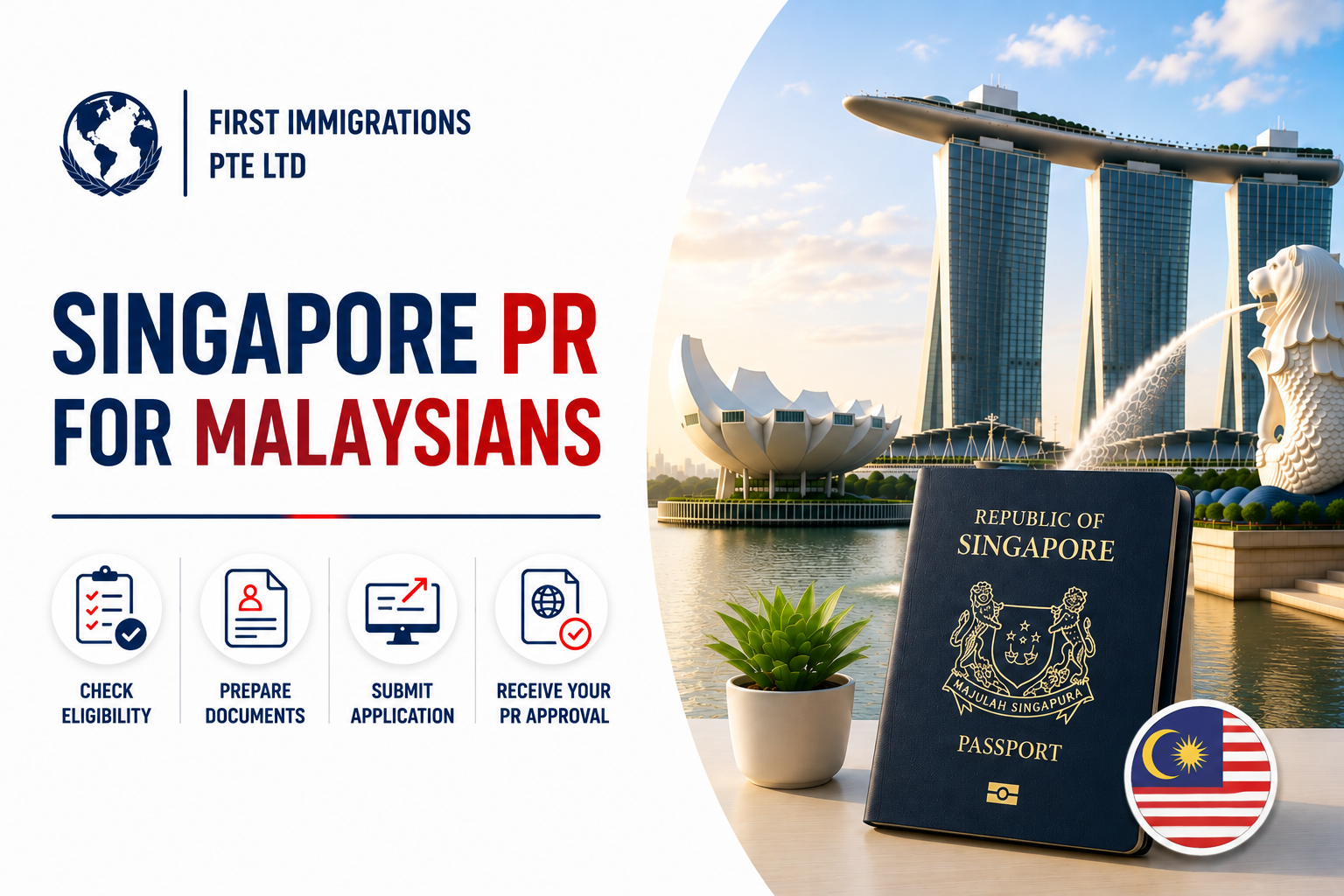
Malaysians are the largest foreign community in Singapore, and among the most common to take up Permanent Residence. Cultural and language proximity, and the short hop across the Causeway, make Singapore a natural move. This guide covers how Malaysians can get Singapore PR in 2026: eligibility, the routes, realistic chances, and Malaysia-specific points to know.
Quick answer: Malaysian citizens usually qualify for Singapore PR through employment (an EP or S Pass under the PTS scheme), family ties, the student route, or the Global Investor Programme. There is no nationality preference, but Malaysians often integrate easily, and their documents are frequently in English, which smooths the process. Most successful applicants apply after two to three years of stable employment. Note that Malaysia, like Singapore, does not allow dual citizenship, which matters only if you later pursue Singapore citizenship, not PR.
Can Malaysians get Singapore PR?
Yes, and they do in large numbers. Malaysians make up the biggest share of Singapore’s foreign-born population. There is no nationality-based advantage or penalty in the rules; ICA assesses every applicant holistically on economic contribution, length of stay, family ties, age, and integration. That said, Malaysians often start with two quiet advantages: cultural and language familiarity that supports genuine integration, and documents that are frequently already in English.
PR routes for Malaysians
You apply under the scheme that fits you.
| Route | Who it is for |
| PTS scheme (most common) | Malaysians working in Singapore on an EP or S Pass |
| Family Ties | Spouse, unmarried child under 21, or aged parent of a citizen or PR |
| Student route | Studied in Singapore 2+ years and passed a national exam |
| Global Investor Programme | High-net-worth investors (from S$10 million) |
The employment route is by far the most common. See our guide on how to apply for Singapore PR.
Eligibility and salary
For the employment route:
- Hold a valid EP or S Pass. EP holders should meet the qualifying salary, currently from S$5,600 a month (S$6,200 in financial services), and pass COMPASS.
- Build a track record. Most successful applicants apply after two to three years of continuous, tax-paying employment.
- Apply after progress. Submitting shortly after a promotion or raise presents your strongest profile.
See our guides on PR eligibility and minimum salary for PR.
Malaysia-specific advantages
- Integration. Shared language, food, and cultural familiarity make it easier to show genuine settlement, which ICA weighs.
- Documents in English. Malaysian certificates and records are often in English, so you may avoid the notarised-translation step other applicants need.
- A common, well-understood profile. Malaysians on the PTS route are a familiar case for ICA.
Malaysia-specific points to consider
- Commuters. Many Malaysians commute daily from Johor. If your life is mostly across the border, that can weaken the “settling in Singapore” signal. Genuine residence and integration in Singapore strengthen a PR case.
- Citizenship later means renouncing Malaysian citizenship. Malaysia, like Singapore, does not allow dual citizenship. This only matters if you go on to apply for Singapore citizenship (which requires giving up your Malaysian passport), not for PR itself. See our guide on whether Singapore allows dual citizenship.
- National Service. If you have sons, male children who become PRs as dependants are NS-liable. See our guide on whether PRs need to serve NS.
How to apply
PR applications are submitted online through ICA’s e-PR portal:
- Apply with Singpass; prepare documents first and upload within the 7-day window.
- Pay the S$100 fee per applicant.
- Processing takes around six months, sometimes longer.
For the full checklist, see our PR application requirements.
How to improve your chances
- Apply at two to three years, not in year one.
- Show salary progression, not a flat income.
- Build and document genuine integration in Singapore.
- Keep your tax and CPF records clean and consistent.
- Apply with family where relevant.
Our PR application tips go deeper.
How First Immigration can help
For Malaysian applicants, the difference between approval and rejection is usually in timing and presentation. First Immigration helps you:
- Assess your realistic chances and the right time to apply.
- Present your profile the way ICA weighs it.
- Prepare a complete, competitive application.
- Plan the path from EP to PR and, later, citizenship.
See our guides on Employment Pass to PR and PR benefits, or speak to our consultants through the contact page.
Frequently asked questions
Can Malaysians get Singapore PR?
Yes. Malaysians can apply through employment (EP or S Pass), family ties, the student route, or the Global Investor Programme. They are the largest group of PR applicants.
Do Malaysians have a better chance of PR?
There is no nationality preference in the rules, but Malaysians often integrate easily and have English-language documents, which can smooth the process. Your profile still decides the outcome.
How long should a Malaysian work in Singapore before applying?
Most successful applicants apply after two to three years of stable employment.
Do I need to renounce my Malaysian citizenship to get PR?
No. PR does not require renouncing anything. Renunciation only applies if you later become a Singapore citizen, since both countries ban dual citizenship.
Does commuting from Johor affect my PR chances?
It can. If your life is mostly across the border, it weakens the settlement signal. Genuine residence and integration in Singapore strengthen your case.
What salary do I need for PR as a Malaysian?
There is no fixed PR salary cut-off, but EP holders should meet the qualifying salary (from S$5,600, or S$6,200 in financial services) and a rising income helps.
Do my sons have to do National Service?
Male children who become PRs as dependants are NS-liable, registering at 16.5 and enlisting around 18.
How long does the PR application take?
Around six months on average, though complex cases can take longer.