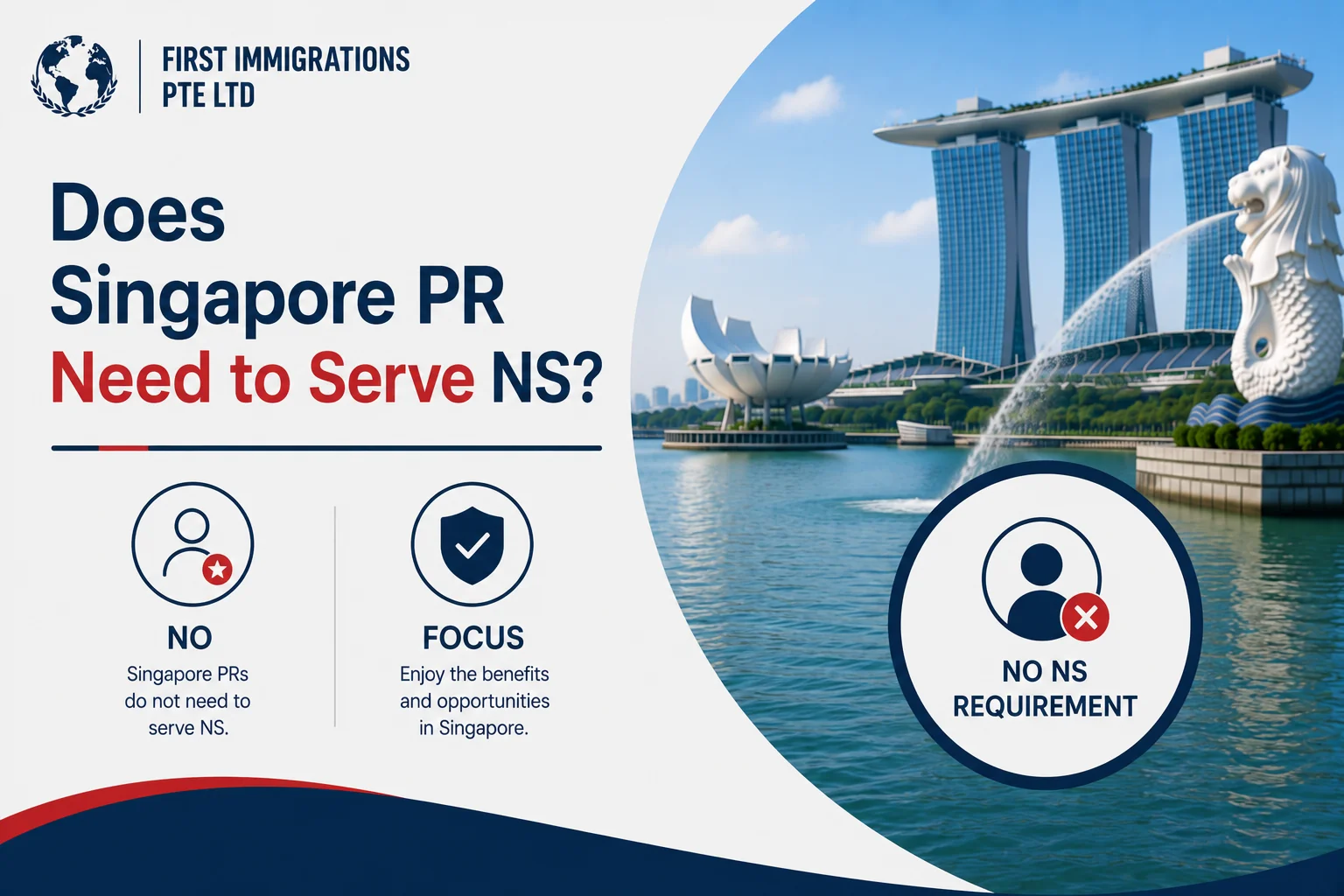
National Service is one of the most important things to understand before your family takes up Singapore PR, especially if you have sons. The short answer is: it depends on who got PR and how. This guide explains exactly which PRs must serve NS, who is exempt, the key ages, and what happens if a son does not serve.
Quick answer: A first-generation PR (the main applicant who got PR as a working professional or investor) generally does not serve NS themselves. But their male children who obtain PR as dependants (second-generation PRs), and males granted PR as foreign students or under a parent’s sponsorship, are required to serve. These sons register at 16.5 and enlist at around 18, and the obligation is lifelong once it applies. Not serving carries serious, lasting consequences.

The short answer: who serves and who doesn’t
|
Who |
NS liable? |
|
First-generation PR (main applicant, PTS or investor scheme) |
No, generally exempt |
|
Female PRs |
No |
|
Second-generation male PRs (granted PR as a dependant child) |
Yes |
|
Male PRs granted PR as a foreign student |
Yes |
|
Male PRs granted PR under a parent’s sponsorship before 16.5 |
Yes |
So the “PR does not serve NS” idea is only half true. It applies to the first-generation adult applicant, not to their sons.
First-generation PRs
If you are the main applicant who obtained PR as an adult under the Professional, Technical and Skilled Workers (PTS) scheme or an investor scheme, you are generally exempt from NS yourself. You took up PR as a working adult, past NS age, so the obligation does not fall on you.
This is the group most people mean when they say “PRs don’t serve NS.” It is true for them, but the picture changes for the next generation.
Second-generation PRs (the key group)
A second-generation PR is a male child who receives PR as a dependant, typically sponsored by a parent who is a PR or citizen. These sons are legally required to serve NS. The same applies to males granted PR as foreign students.
Once a son becomes NS-liable, the obligation is effectively lifelong. It does not simply lapse if he moves away, and it shapes his future ability to live, work, study, or apply for citizenship in Singapore.
The key factor: age when PR was granted
Liability turns on when the male obtained PR. In general:
- A male granted PR before turning 16.5 (as a dependant or foreign student) is NS-liable.
- A male granted PR after 16.5 is generally not liable.
The precise cut-off is defined around 1 January of the year he turns 16.5. Because individual cases vary, confirm a specific situation with CMPB or ICA.
What National Service involves
NS is mandatory service for Singapore’s defence and security, under the Enlistment Act. In outline:
- Full-time service of two years.
- Reservist duty afterwards as an Operationally Ready NSman, with annual In-Camp Training (typically one to two weeks a year) for years after.
- Posting to the Singapore Armed Forces (SAF), Singapore Civil Defence Force (SCDF), or Singapore Police Force (SPF).
- A pre-enlistment medical that grades fitness (PES status), which affects vocation and deployment.
Key ages and timeline
|
Age |
What happens |
|
16.5 |
Must register for NS |
|
From 16.5 |
Needs a valid Exit Permit to remain overseas for 3 months or more |
|
Around 18 |
Enlists for full-time NS at the earliest opportunity |
|
After full-time NS |
Becomes an NSman with annual reservist training |
Deferment is limited. It is generally granted only to complete pre-university education; deferment to finish a university degree is usually not allowed.
Travelling and living overseas
An NS-liable son can travel, but there are rules once he is registered:
- Exit Permit. A valid Exit Permit is required to remain overseas for three months or longer.
- Bond. A male under 16.5 who plans to stay abroad for three months or more must post a bond, set at S$75,000 or 50% of his parents’ combined annual gross income, whichever is higher. The bond is to ensure he returns to fulfil NS.
Staying overseas without a valid Exit Permit after registration age is an offence.
Can you renounce PR to avoid NS?
This is the question many families ask, and the answer is a firm caution. Once a male is NS-liable, renouncing PR to avoid serving does not make the problem go away. Instead it “burns bridges” with Singapore:
- He faces a near-total bar on future study, work, or living in Singapore.
- Future PR or citizenship applications, for him and often for family members, are very likely to be rejected.
- It can affect the family’s own Re-Entry Permit renewals and citizenship prospects.
In practice, serving NS is what keeps a son’s (and often the family’s) future options in Singapore open. Renouncing to dodge it closes them.
Penalties for NS evasion
NS is not optional. Failing to register, enlist, or return to serve can lead to:
- Fines of up to S$10,000 and/or imprisonment of up to three years.
- Withdrawal of PR status.
- Damage to future immigration applications for the individual and family.
What this means for families considering PR
If you have sons, factor NS into your decision from the start. It is a genuine commitment, but it is also part of what integrates a family into Singapore and, for many, a reasonable trade for the benefits of PR. NS is also one reason Singapore does not allow adult dual citizenship, covered in our guide on whether Singapore allows dual citizenship, and a key difference in our comparison of PR vs citizen.
How First Immigration can help
NS obligations are one of the most consequential parts of a family’s PR decision. First Immigration helps you:
- Understand exactly who in your family would be NS-liable and when.
- Plan a PR or citizenship application with NS in mind.
- Avoid the costly mistakes that damage a family’s long-term standing in Singapore.
To weigh PR for your family, see our guide on how to apply for Singapore PR, or speak to our consultants through the contact page.
Frequently asked questions
Do Singapore PRs need to serve NS?
First-generation PRs (the main applicant who got PR as a working professional or investor) generally do not. But their male children who obtain PR as dependants, and males granted PR as foreign students, are required to serve.
Do first-generation PRs serve NS?
No. A main applicant who obtained PR as an adult under the PTS or investor scheme is generally exempt from NS.
Who are second-generation PRs?
Male children who receive PR as dependants, usually sponsored by a PR or citizen parent. They are legally required to serve NS.
At what age does NS liability start?
An NS-liable male must register at 16.5 and enlists at around 18. Liability generally applies if he obtained PR before turning 16.5.
How long is National Service?
Two years of full-time service, followed by reservist duty as an NSman with annual In-Camp Training.
Can a PR renounce status to avoid NS?
Renouncing to avoid NS has severe, lasting consequences: a near-total bar on future study, work, or living in Singapore, and rejection of future PR or citizenship applications for the individual and often the family.
What are the penalties for not serving NS?
Fines up to S$10,000 and/or up to three years’ imprisonment, withdrawal of PR status, and damage to future immigration applications.
Does my son need an Exit Permit to travel?
Once registered, he needs a valid Exit Permit to remain overseas for three months or more, and a bond may apply for those under 16.5 planning a long stay abroad.
Do female PRs serve NS?
No. National Service applies to males only.