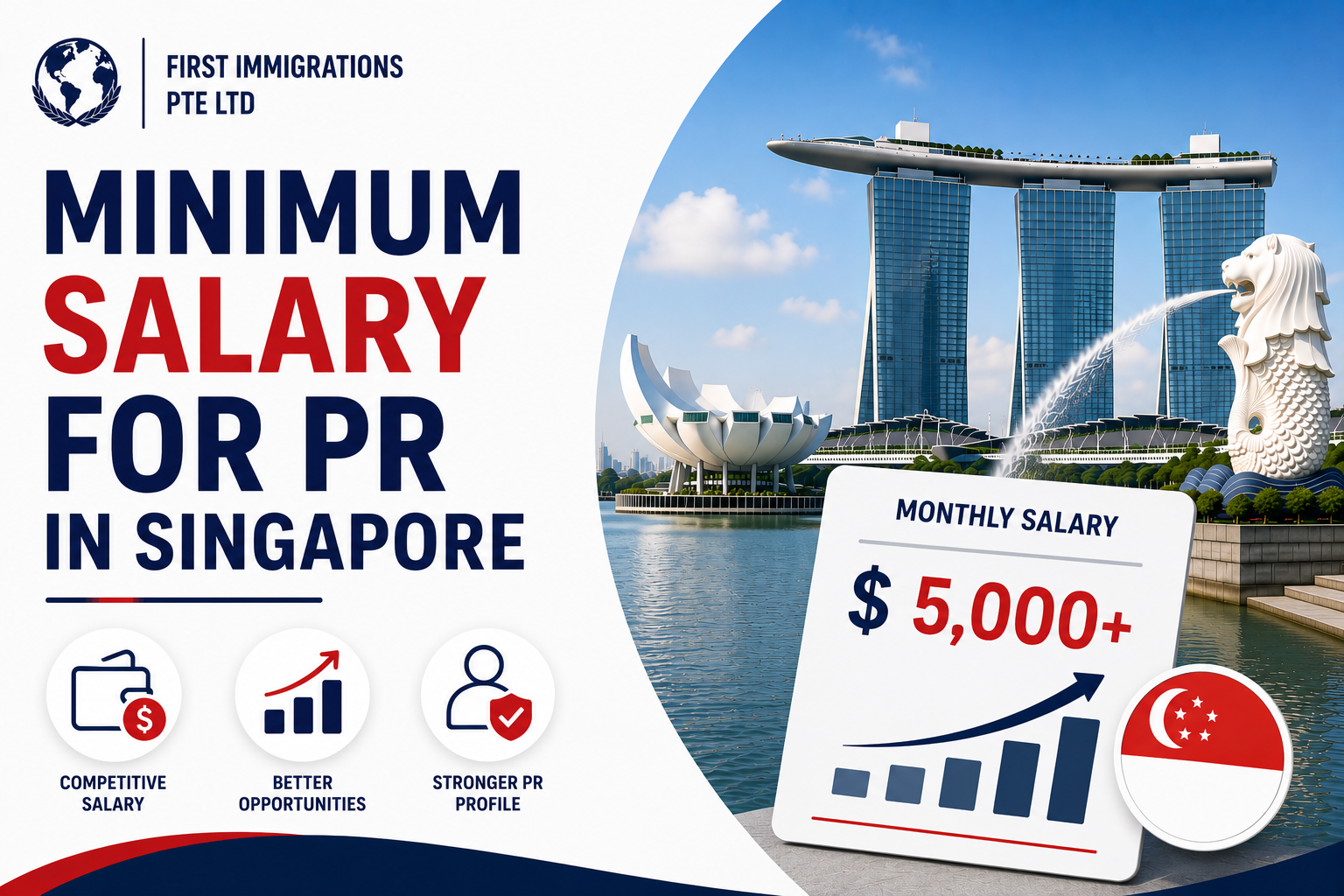
One of the most common PR questions is also one of the most misunderstood: what is the minimum salary to get Singapore PR? The honest answer is that there is no official figure. But that does not mean income is unimportant, and there are clear practical benchmarks. This guide explains what you actually need to earn to be competitive in 2026.
Quick answer: There is no official minimum salary to apply for Singapore PR; ICA does not publish one. The practical floor is your work pass qualifying salary (from S$5,600 for an Employment Pass, or S$3,300 for an S Pass). To be genuinely competitive, most successful work-pass applicants earn around S$6,000 to S$10,000 a month, and higher in finance or tech. Salaries around S$4,500 to S$5,000 can still succeed with strong compensating factors, because ICA weighs income alongside everything else.
Is there a minimum salary for PR?
No. ICA does not set or publish a minimum salary for Permanent Residence. PR is assessed holistically, so income is one factor among many, weighed with your qualifications, length of stay, age, family ties, and integration.
That is why you cannot “buy” PR with a high salary alone, and why a modest earner with strong roots can sometimes succeed where a high earner who just arrived does not.
The practical baseline: work pass salary floors
While there is no PR salary cut-off, you generally apply on a work pass, and that pass has its own minimum. In effect, these are the floor to even be eligible.
| Pass | Minimum qualifying salary (2026) | Note |
| Employment Pass (EP) | From S$5,600/month (S$6,200 financial services) | Rising to S$6,000 / S$6,600 in January 2027 |
| S Pass | From S$3,300/month (S$3,800 financial services) | Rises with the candidate’s age |
Meeting your pass’s salary is the starting point, not a competitive PR salary. For the EP detail, see our guide on Employment Pass eligibility.
What a competitive PR salary looks like
Based on observed approvals, here is roughly how salary bands map to your odds, for a work-pass applicant with otherwise reasonable tenure.
| Monthly salary | Rough read on odds |
| Below ~S$4,500 | Difficult; the rest of your profile must be strong |
| S$4,500 to S$5,000 | Borderline; can succeed with strong compensating factors |
| S$6,000 to S$10,000 | Competitive; a common range for approvals |
| S$12,000 and above | Strong, especially in high-demand sectors |
These are patterns, not guarantees. A higher salary helps, but it is read together with your whole profile, not on its own.
Why salary is not the whole story
Three things matter as much as the number:
- Progression beats a flat figure. A salary that has risen year on year signals an “up-and-comer”. A high but static salary is weaker than a rising one.
- It is benchmarked. ICA effectively compares your pay against local peers of your age and sector. The same figure looks different at 28 than at 45.
- Sector counts. Salaries in finance, tech, healthcare, and engineering carry weight, and these sectors often expect higher pay to be competitive.
For how income sits alongside the other factors, see our guides on what ICA really evaluates and the factors that affect your PR chances.
If your salary is on the lower side
A salary near the floor is not the end of the road. You can strengthen the rest of your case:
- Show a rising trajectory, even from a modest base.
- Build a longer track record of stable, tax-paying employment.
- Evidence genuine integration in the community.
- Apply with family where relevant, and lean on any family ties in Singapore.
- Time it after a raise or promotion, so your most recent income is your strongest.
Our PR application tips and guide on the best time to apply go deeper.
How to strengthen the income part of your case
- Push for progression before you apply, since a recent raise strengthens the picture.
- Keep a clean, consistent tax and CPF record that matches your payslips.
- Apply once your income is stable and rising, not during a low or transitional year.
How First Immigration can help
Because there is no magic number, the real question is whether your income, in the context of your whole profile, is strong enough now. First Immigration helps you:
- Assess whether your salary and profile are competitive, or worth strengthening first.
- Time your application around your income and career.
- Present your economic contribution the way ICA weighs it.
Whether you are moving from Employment Pass to PR or unsure where you stand, speak to our consultants through the contact page.
Frequently asked questions
What is the minimum salary to get Singapore PR?
There is no official minimum. ICA does not publish a salary threshold for PR. In practice, you apply on a work pass (from S$5,600 for an EP, or S$3,300 for an S Pass), and most competitive applicants earn around S$6,000 to S$10,000 a month.
Do I need to earn S$6,000 to get PR?
Not strictly, but S$6,000 or more is a common benchmark for stronger odds. Salaries around S$4,500 to S$5,000 can succeed with strong qualifications, tenure, and integration.
Does a higher salary guarantee PR?
No. A higher salary helps, but ICA weighs income alongside your qualifications, tenure, age, family ties, and integration. You cannot secure PR on salary alone.
Is salary progression important?
Yes. A rising salary signals career growth and is often more persuasive than a high but static figure.
What salary do I need on an S Pass to apply for PR?
You must at least meet the S Pass qualifying salary (from S$3,300, or S$3,800 in financial services). To be competitive, a higher, progressing salary and a longer track record help.
Is the PR salary benchmark higher in finance or tech?
Effectively yes. Salaries are read against local peers by age and sector, and high-demand sectors like finance and tech often expect higher pay to be competitive.
Can I get PR with a salary below S$5,000?
It is harder, but possible if the rest of your profile is strong: a rising income, solid tenure, family ties, and genuine integration.
Will the 2027 salary increases affect my PR chances?
The rising EP floors (S$6,000 general, S$6,600 financial from January 2027) raise the practical baseline. A salary comfortably above the floor remains the stronger position.