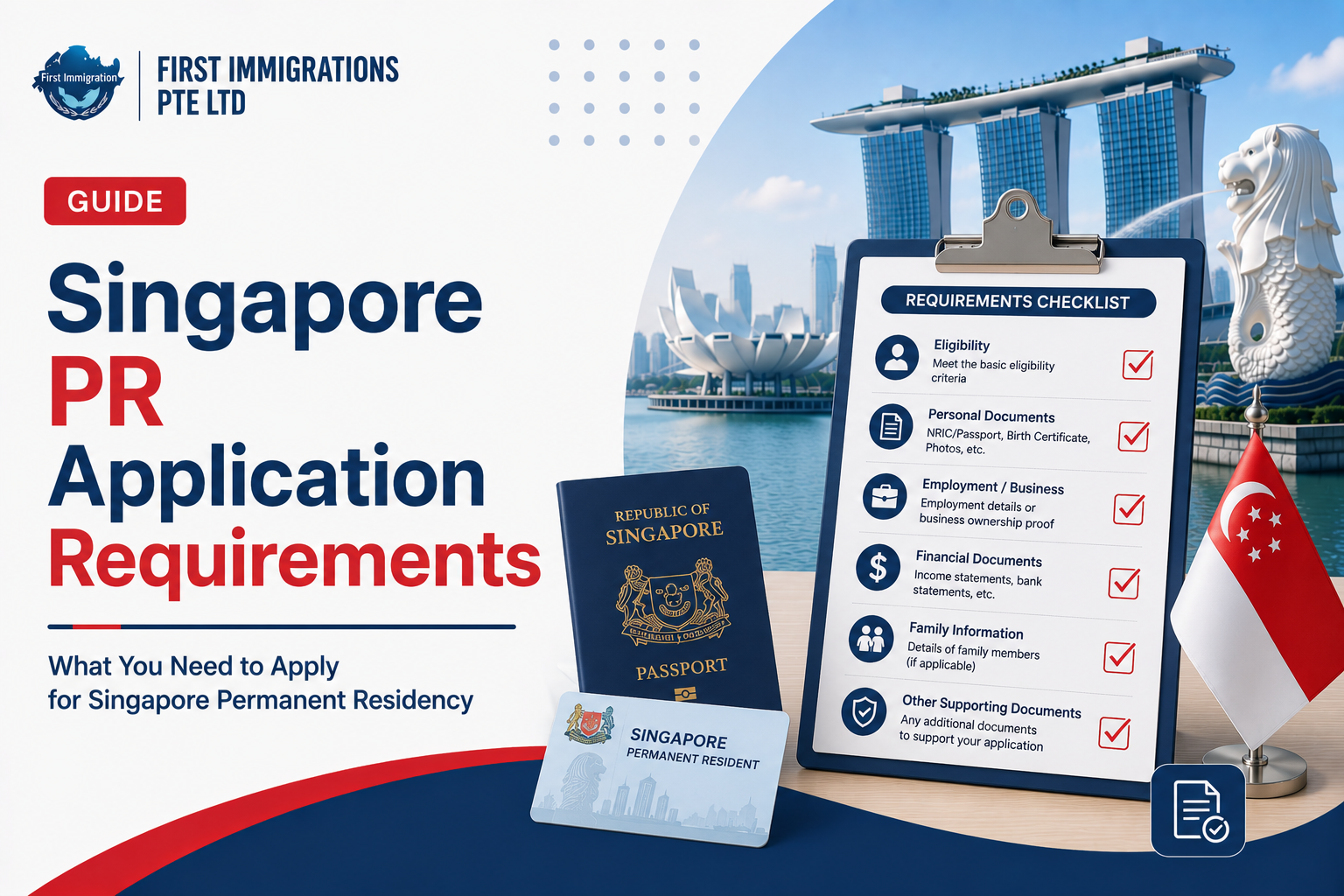
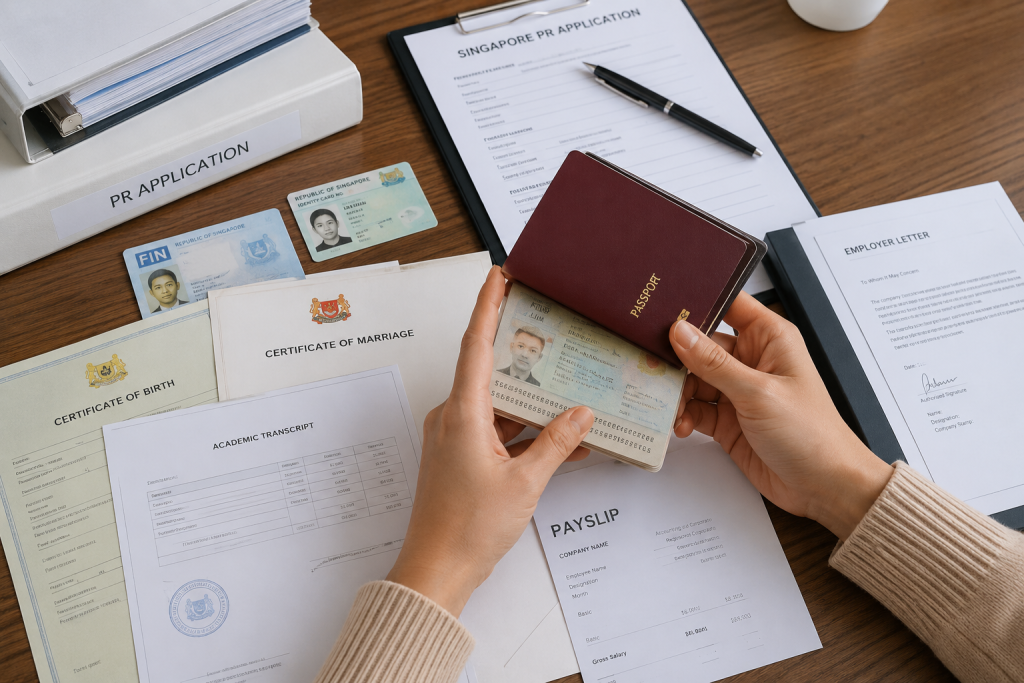
A Singapore PR application is only as strong as its documents. A complete, well-organised, consistent file signals a serious applicant; a missing translation or a blurry scan stalls everything. This guide is a full requirements and document checklist for Singapore PR in 2026, organised by applicant type and by category, with the format rules and pitfalls to avoid. Use it as a checklist you can tick off before you submit.
Quick answer: Every applicant needs identity documents (passport, NRIC or FIN, birth certificate, photo), employment and financial documents (work pass, employer letter dated within 3 months, six months of payslips), education certificates, and family documents where relevant. What you add depends on your route: family, student, or self-employed and investor applicants each need extras. Upload clear colour PDFs through ICA’s e-PR portal with Singpass, and provide notarised English translations for any non-English document.
Why your documents matter so much
ICA assesses PR holistically, but it can only assess what you give it. Complete, consistent documents do two things: they prove your economic contribution and ties, and they signal that you are organised and credible. Incomplete or inconsistent paperwork is one of the most common, and most avoidable, reasons an application is delayed or refused. Get this right and you remove a whole category of risk.
Requirements by applicant type
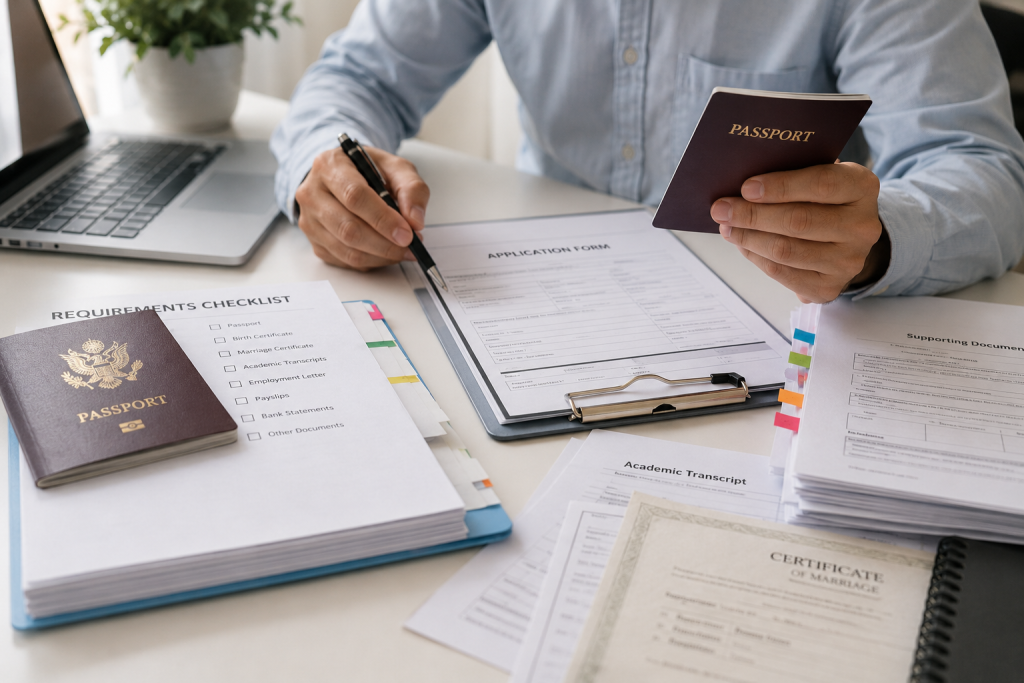
Start with the set for your route, then add the universal documents below.
Employment Pass / S Pass holders (PTS scheme)
- Current work pass (EP, S Pass, PEP, or EntrePass)
- Employer letter dated within the last 3 months (job title, start date, basic and gross salary)
- Last six months of payslips
- Educational certificates and transcripts
- Company’s ACRA business profile (if requested)
Family Ties (spouse, child, or aged parent of a citizen or PR)
- Marriage certificate (for a spouse)
- Children’s birth certificates
- Sponsor’s NRIC and proof of citizenship or PR status
- Your current pass (DP, LTVP, or work pass)
Foreign students
- Certificate of a passed national exam (PSLE, GCE N/O/A level) or Integrated Programme record
- Academic transcripts or school enrolment letters
- Student pass details
- Parents’ or guardians’ PR or employment details
Self-employed and investors
- ACRA business profile and business registration
- Proof of shareholding
- Recent balance sheets and profit and loss statements
- Personal and company tax records
- CPF records for local employees
For the business route, see our guides on the self-employed EP route to PR and PR by investment.
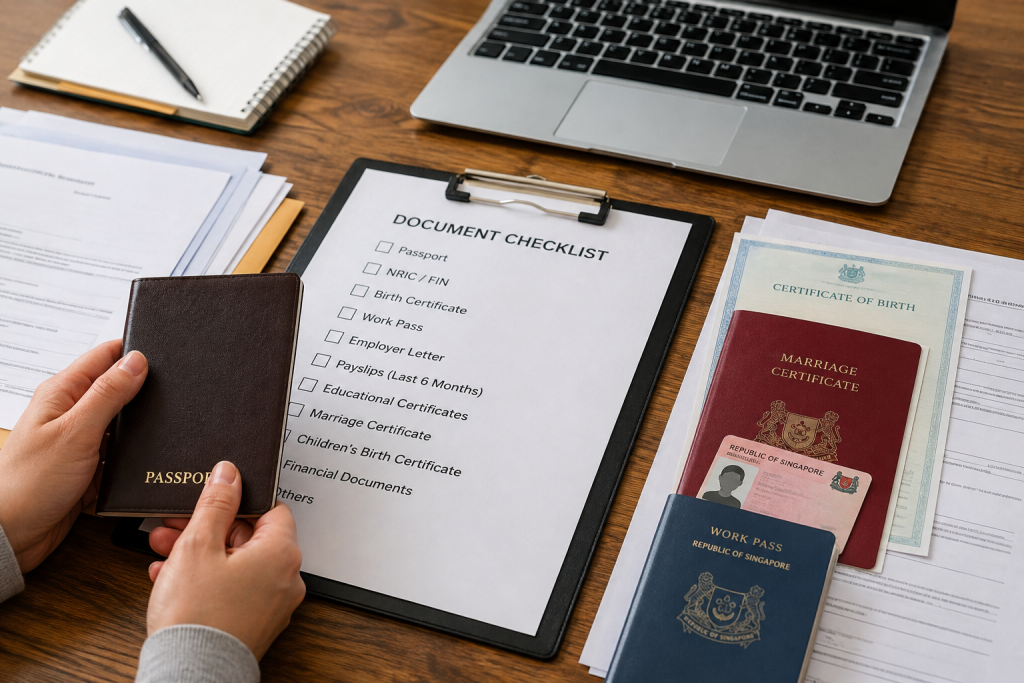
Universal checklist (all applicants), by category
Identity and personal
- Passport biodata page (and all previous passports)
- NRIC or FIN (both sides where applicable)
- Birth certificate
- Recent colour passport-style photograph (white background, ICA specifications)
- Deed poll or change-of-name certificate (if you have changed your name)
Employment and financial
- Employer letter (within 3 months)
- Six months of payslips
- Proof of income and, where relevant, tax records
Education and professional
- Degrees, diplomas, and academic transcripts
- Professional licences and memberships
Family and relationship
- Marriage certificate
- Children’s birth certificates
- Divorce or custody documents (if applicable)
A typical strong application runs to around 12 to 15 documents once supporting materials are added.
Format and submission rules
Getting the format right matters as much as having the documents.
| Rule | Detail |
| File type | PDF or JPG, clear and colour |
| File size | Within ICA’s limit (commonly up to about 2MB per file) |
| Naming | A clear convention, such as “[Your Name]_[Document Type]” |
| Quality | High resolution, no glare or shadows, all details legible; seals and signatures visible |
| Translation | Non-English documents need an official, notarised (or embassy-attested) English translation |
| Submission | Uploaded through ICA’s e-PR portal with Singpass, within the 7-day window |
Education documents: local vs foreign
| Document | Local qualification | Foreign qualification |
| Certificate | Certified copy | Certified copy plus official translation |
| Transcript | Certified copy | Certified copy, notarised |
2026 update: ICA now draws on MOM, IRAS, and ACRA data directly, so the Annex A form and IRAS Notices of Assessment are generally no longer required. Keep tax records handy and check the current official ICA checklist for your route.
Tips to organise your documents
- Keep both digital and physical copies. Upload clean PDFs, but keep the originals for any verification.
- Label and file clearly. Follow a naming convention and group related documents, so nothing is missed.
- Keep everything current and certified. Check expiry dates (passport at least 6 months’ validity), and ensure translations and certifications are recent.
- Prepare before you start. Once you begin the online application, you have only seven days to upload everything.
Common pitfalls to avoid
| Pitfall | Why it hurts |
| Incomplete passport history | ICA wants all previous passports; a gap causes delays |
| An out-of-date employer letter | It must be dated within the last three months |
| Blurry or cropped scans | Illegible files get queried or rejected |
| Inconsistent details | Names, dates, and salary must match across every document and the form |
| Uncertified translations | Self-translated documents are rejected |
| Missing family or financial documents | Gaps weaken or stall the application |
For a deeper walkthrough, see our guide on what to include in your PR documents.
How First Immigration can help
A complete, consistent, well-organised document set is the foundation of a credible application. First Immigration helps you:
- Assemble the right documents for your route.
- Get translations, passport history, and the employer letter right.
- Cross-check financials and present everything consistently.
- Prepare a strong cover letter and supporting materials alongside.
See our guides on how to apply for Singapore PR and PR application tips, or speak to our consultants through the contact page.
Frequently asked questions
What are the requirements to apply for Singapore PR?
You generally need to be living and working in Singapore on an eligible pass (EP, S Pass, PEP, or EntrePass), or be the spouse, child, or aged parent of a citizen or PR. You then submit core documents (passport, work pass, payslips, employer letter, educational and birth certificates) digitally through ICA.
Is there a minimum salary to apply for PR?
There is no fixed PR salary cut-off, but EP holders should meet the qualifying salary (from around S$5,600, or S$6,200 in financial services) and pass COMPASS. Salary is assessed alongside your whole profile.
What documents do I need for a Singapore PR application?
At minimum: a recent colour photo, your passport, national ID, current work pass, an employer letter dated within three months, six months of payslips, educational certificates, and your birth certificate. Family applicants add marriage and birth certificates; the self-employed add business financials.
Do I need to translate my documents?
Yes, any non-English document needs an official translation that is notarised or embassy-attested. ICA does not accept self-translated documents.
How do I submit my PR application?
Online, through the ICA e-Service portal, with documents uploaded digitally. For family routes, the citizen or PR sponsor logs in to start the application.
How long does a Singapore PR application take?
Usually around six months, sometimes longer for complex profiles. ICA does not give progress updates during assessment.
Do I still need to submit my IRAS tax assessment?
Recent ICA guidance indicates the IRAS Notice of Assessment and the Annex A form are no longer required, as ICA accesses tax data directly. Check the current official checklist for your application type.
Who can sponsor a family PR application?
A Singapore citizen or PR sponsors a foreign spouse, an unmarried child under 21, or (for citizens) an aged parent, by initiating the application through ICA’s e-Service.
Does meeting the requirements guarantee PR approval?
No. Requirements get your application accepted for assessment. ICA then judges your overall profile, so a strong, well-presented case matters as much as meeting the minimums.