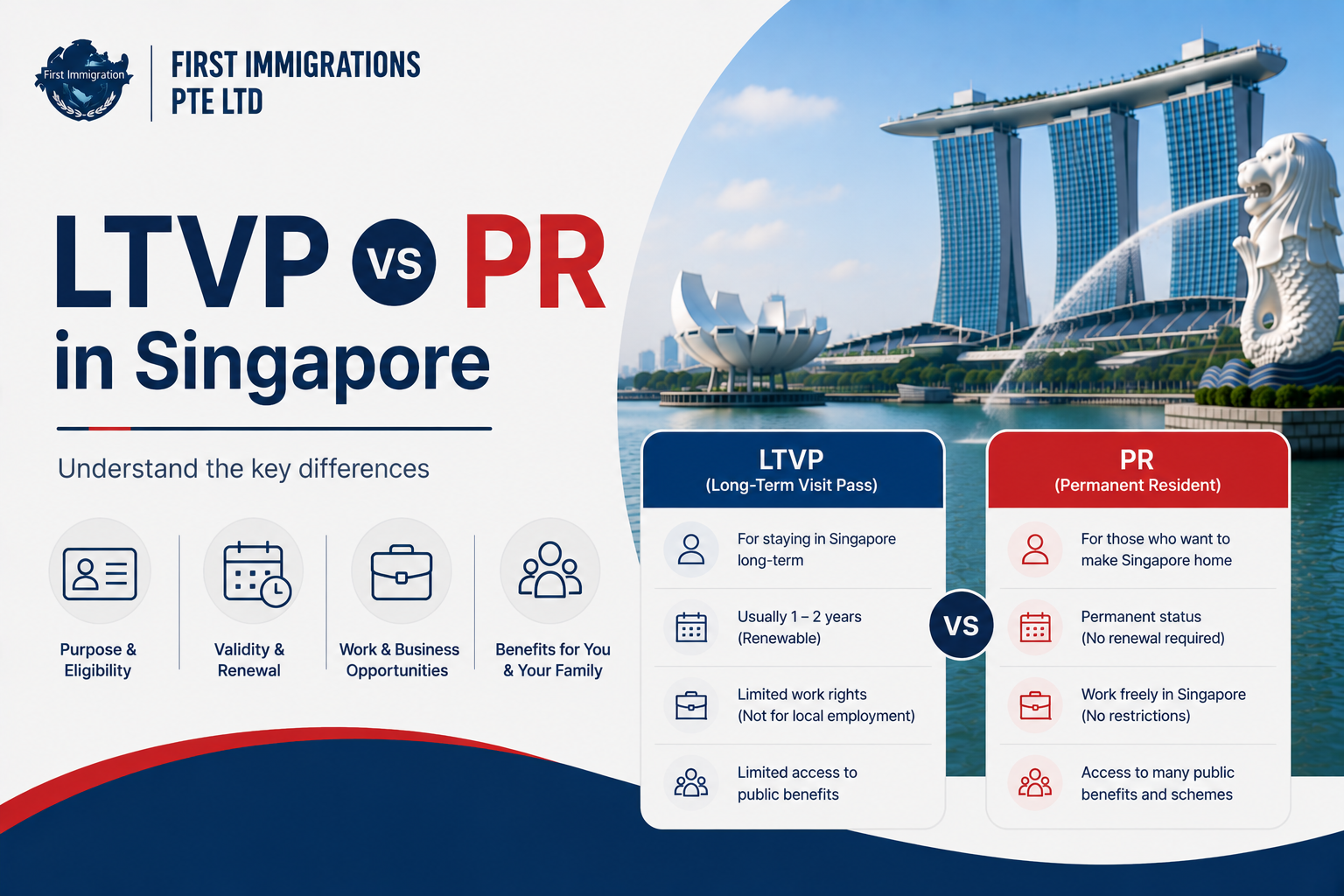
The Long-Term Visit Pass (LTVP) and Permanent Residence (PR) both let a foreigner stay in Singapore long term, but they are worlds apart in what they give you. One is a temporary pass tied to a sponsor; the other is a status you hold in your own right. This guide compares LTVP vs Singapore PR side by side so you know which you have, which you want, and how to move from one to the other.
Quick answer: An LTVP is a temporary, renewable pass (usually 1 to 2 years) that depends on a sponsor and does not include the right to work, CPF, or subsidised healthcare on its own. PR is permanent, held in your own right, and comes with unrestricted work rights, CPF, subsidised healthcare, resale HDB eligibility, and far lower property stamp duty. PR is the far stronger status; an LTVP is often the bridge families use while building toward a PR application.
At a glance: LTVP vs PR
| Feature | Long-Term Visit Pass (LTVP) | Permanent Residence (PR) |
| Nature | Temporary pass, tied to a sponsor | Permanent status, held in your own right |
| Duration | Usually 1 to 2 years (LTVP+ up to 3 to 5 years for spouses of citizens) | Permanent; no renewal of status |
| Right to work | Not automatic; needs a Letter of Consent | Unrestricted; no work pass needed |
| CPF | No | Yes, with employer contributions |
| Healthcare subsidies | Very limited | Yes, plus MediShield Life |
| Housing | Very limited property rights | Resale HDB eligible; ABSD 5% vs 60% for foreigners |
| Identity document | Long-term pass | Blue NRIC and Re-Entry Permit |
| Path forward | Can support a later PR application | Can lead to citizenship |
What is an LTVP?
The Long-Term Visit Pass regularises the stay of an eligible foreigner for a set period. It is sponsor-dependent, typically issued to the common-law spouse, parents, stepchildren, or other family of a work pass holder, or to the foreign family of a Singapore citizen or PR.
Key points:
- It is temporary and renewable, usually valid one to two years and renewed alongside the sponsor.
- LTVP+ is an enhanced version for foreign spouses of Singapore citizens, offering a longer validity (up to three to five years) and some additional benefits.
- It does not include the right to work. An LTVP holder generally needs a Letter of Consent (LOC) from an employer to take a job; LTVP+ holders may qualify for a pre-approved LOC.
For how the LTVP compares to the Dependant Pass, see our guide on the LTVP vs Dependant Pass.
What is PR?
Permanent Residence is a status you hold in your own right, not tied to a sponsor or an employer. It lets you live and work in Singapore indefinitely and unlocks the benefits that matter financially: CPF, subsidised healthcare, resale HDB eligibility, and much lower property stamp duty. For the full list, see our guide on Singapore PR benefits.
The differences that matter
Security and permanence
An LTVP is temporary and depends on your sponsor; if the sponsorship ends or the pass is not renewed, your right to stay ends with it. PR is permanent and yours. You do keep a Re-Entry Permit to travel and preserve PR, but the status itself does not expire like a pass.
The right to work
This is the biggest practical gap. An LTVP does not let you work automatically; you need an employer to secure a Letter of Consent first. A PR needs no permission to work, can change jobs freely, and attracts no levy or quota, which makes a PR far easier to hire.
CPF and healthcare
CPF, Singapore’s mandatory savings scheme for housing, retirement, and healthcare, applies only to citizens and PRs. LTVP holders have no CPF and only very limited healthcare subsidies. A PR builds CPF savings with employer contributions and gets meaningful healthcare subsidies plus MediShield Life.
Housing and property
A PR can buy a resale HDB flat (after three years) and pays 5% stamp duty on a first private home, against 60% for a foreigner. LTVP holders have very limited property rights. Over a few years, this difference alone can be worth tens of thousands of dollars.
Can you move from LTVP to PR?
Yes, and many families do. Holding an LTVP does not automatically qualify you for PR, and approval depends on the usual factors (economic contribution, length and stability of stay, family ties, and integration) rather than your pass type. But an LTVP is a common bridge: you use it to live in Singapore and build the residence and work history that supports a strong PR application later.
When you are ready, our guides on how to apply for Singapore PR and PR application tips show what a competitive case looks like.
Which do you have, and which do you want?
- You hold an LTVP if you are here as the sponsored family member of a work pass holder, citizen, or PR. It keeps you in Singapore, but with limited rights.
- You want PR if you plan to stay long term and want to work freely, build CPF, buy an HDB flat, and access subsidies. PR is the stronger position, and the natural next step from a settled LTVP.
For the step beyond PR, see our comparison of PR vs citizen.
How First Immigration can help
Moving from a temporary pass to permanent status is a big step, and timing matters. First Immigration helps you:
- Understand exactly what your current pass allows.
- Judge when your profile is strong enough to apply for PR.
- Prepare a competitive PR application.
- Plan the longer path toward citizenship if that is your goal.
Explore our LTVP application service, or speak to our consultants through the contact page.
Frequently asked questions
What is the difference between an LTVP and PR in Singapore?
An LTVP is a temporary, sponsor-dependent pass with limited rights and no automatic right to work. PR is permanent status held in your own right, with unrestricted work rights, CPF, subsidised healthcare, and HDB eligibility.
Can an LTVP holder work in Singapore?
Not automatically. They generally need a Letter of Consent from an employer. LTVP+ holders (spouses of citizens) may get a pre-approved LOC.
How long is an LTVP valid?
Usually one to two years, renewed with the sponsor. LTVP+ for spouses of citizens can be valid three to five years.
Do LTVP holders get CPF or subsidised healthcare?
No. CPF and full healthcare subsidies apply to citizens and PRs. LTVP holders have very limited access.
Can I upgrade from LTVP to PR?
You cannot upgrade automatically, but you can apply for PR. An LTVP is often used as a bridge while you build the profile that supports a PR application.
Is PR better than an LTVP?
For long-term settlement, yes. PR offers permanence, the right to work, CPF, healthcare subsidies, and housing benefits that an LTVP does not.
Does holding an LTVP help my PR application?
It shows continuous residence, which supports your case, but PR approval depends on your overall profile, not your pass type.
What comes after PR?
Citizenship. After holding PR for at least two years you may apply, though becoming a citizen requires renouncing other nationalities.