If you are bringing family to Singapore, two passes come up: the Dependant Pass (DP) and the Long-Term Visit Pass (LTVP). They sound similar but cover different people, are issued by different authorities, and come with different work rights and fees. This guide compares the Long-Term Visit Pass vs the Dependant Pass side by side so you apply for the right one the first time.
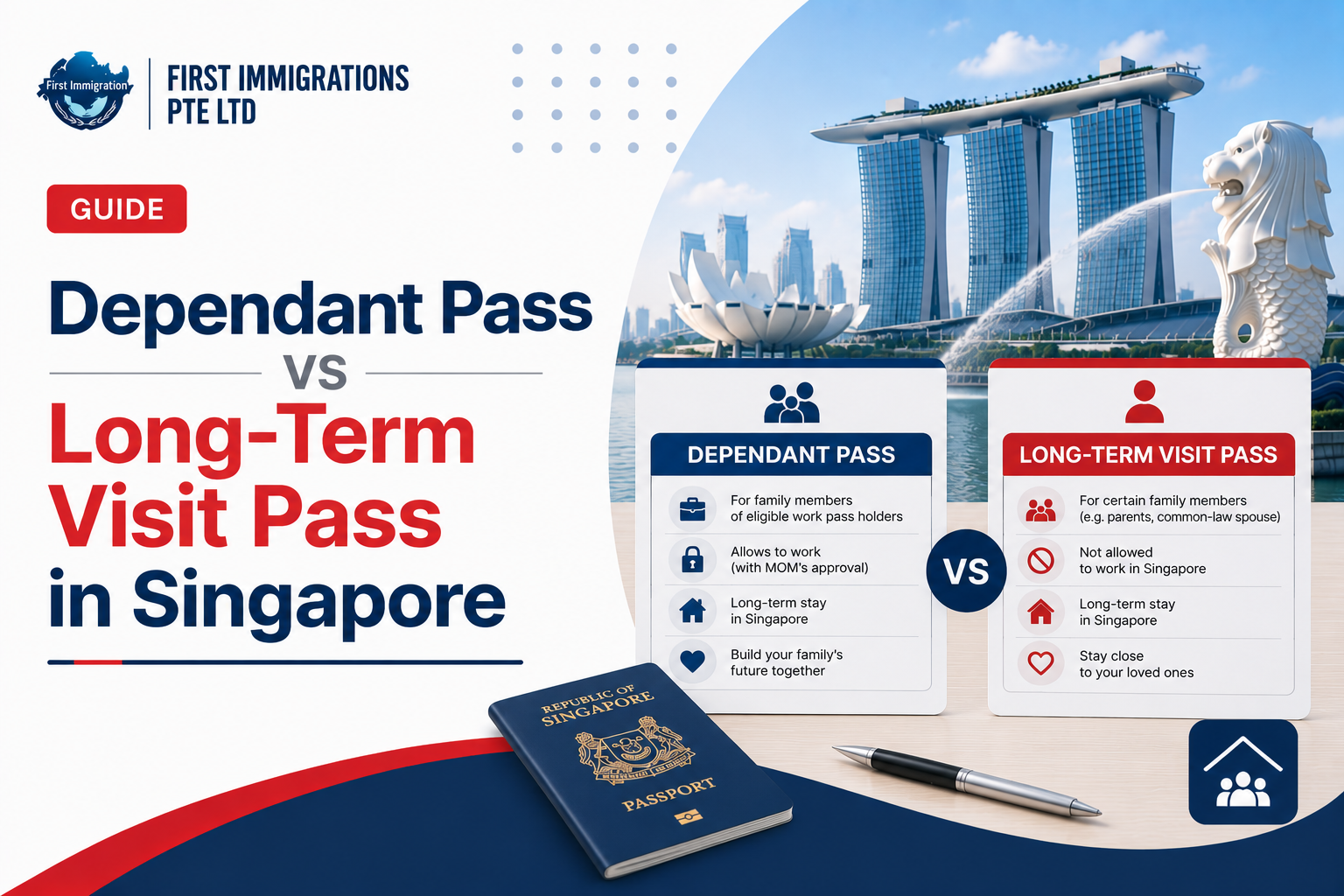
Quick answer: The Dependant Pass is for the immediate family of an eligible work pass holder: a legally married spouse and unmarried children under 21, sponsored by an EP or S Pass holder earning at least S$6,000 a month, and issued by MOM. The Long-Term Visit Pass covers everyone else: common-law spouses, stepchildren, handicapped children over 21, and parents (sponsor must earn at least S$12,000), plus the foreign family of Singapore citizens and PRs. LTVP is issued by MOM or ICA depending on the sponsor. Neither pass lets the holder work automatically. (The Dependant Pass is also written “Dependent Pass”.)
At a glance: LTVP vs Dependant Pass
| Feature | Dependant Pass (DP) | Long-Term Visit Pass (LTVP) |
| Who it covers | Legal spouse; unmarried children under 21 | Common-law spouse; stepchild; handicapped child over 21; parents; foreign family of Citizens/PRs |
| Sponsored by | EP, S Pass, PEP, ONE Pass, EntrePass, Tech.Pass holder | Same work-pass holders (for wider family), or a Singapore Citizen/PR |
| Sponsor salary | At least S$6,000/month | At least S$6,000 (spouse/child); at least S$12,000 to sponsor parents |
| Issuing authority | MOM | MOM (work-pass route) or ICA (Citizen/PR route) |
| Right to work | Must apply for own work pass; the old Letter of Consent route closed in 2021 | Generally must apply for own work pass; an LTVP holder married to a Citizen/PR may get a Letter of Consent |
| Validity | Tied to the sponsor’s pass | Tied to the sponsor’s pass or status |
| Typical fees | Around S$105 (submission + issuance) | ICA route about S$105; MOM route about S$330 |
Salary thresholds and fees reflect current 2026 rules and can change. Confirm the latest figures with MOM or ICA before applying.
What is a Dependant Pass?
The Dependant Pass lets the immediate family of a qualifying work pass holder live in Singapore. It is issued by the Ministry of Manpower (MOM) and is the more privileged of the two passes, because it is reserved for close family.
Who qualifies for a DP:
- The legally married spouse of the pass holder.
- Unmarried children under 21, including legally adopted children.
Who can sponsor: holders of an Employment Pass, S Pass, Personalised Employment Pass (PEP), ONE Pass, EntrePass, or Tech.Pass, earning a fixed monthly salary of at least S$6,000. Fixed salary means basic pay plus fixed allowances; it does not include bonuses, overtime, commissions, or employer CPF.
For more on the sponsoring pass, see our guides to the Employment Pass and S Pass.
What is a Long-Term Visit Pass?
The Long-Term Visit Pass is the catch-all for family who fall outside DP eligibility. It comes in two routes depending on who sponsors it.
Work-pass route (issued by MOM): for the wider family of an EP or S Pass holder, such as:
- A common-law spouse.
- A stepchild or handicapped child who is not covered by a DP.
- Parents, but only if the sponsor earns at least S$12,000 a month.
Citizen/PR route (issued by ICA): for the foreign family of a Singapore Citizen or PR, such as a foreign spouse, unmarried children under 21, or parents.
The right route matters, because the issuing authority (MOM or ICA) affects the process, the fees, and the work options.
The differences that matter, explained
Who qualifies
The Dependant Pass is narrow: spouse and minor children only. The LTVP is broad: it exists precisely for the relationships a DP will not cover, including common-law partners, older or step children, and parents. If your family member does not fit the DP definition, the LTVP is usually the route.
Sponsor salary thresholds
Both passes depend on the sponsor earning enough.
| Family member | Minimum sponsor salary |
| Spouse or child (DP) | S$6,000/month |
| Spouse or child (LTVP, work-pass route) | S$6,000/month |
| Parents (LTVP) | S$12,000/month |
Parents are the big step up: you need to earn at least S$12,000 to bring them over on an LTVP.
Issuing authority: MOM or ICA
A Dependant Pass is always a MOM matter. An LTVP can be issued by MOM (when the sponsor is a work pass holder) or by ICA (when the sponsor is a Singapore Citizen or PR). Knowing which authority handles your case tells you where to apply and what fees to expect.
The right to work
This is where many people are caught out. Neither pass allows the holder to work automatically. To take a job, a DP or LTVP holder generally needs to obtain their own Employment Pass, S Pass, or Work Permit.
There is one useful exception. The Letter of Consent (LOC) that once let Dependant Pass holders work was closed to new applicants in 2021, so new DP holders cannot use it. However, an LTVP holder who is married to a Singapore Citizen or PR can still apply for an LOC to work. So for work flexibility, the LTVP-via-Citizen/PR route can actually be more generous than a DP.
Fees
Costs differ by route. As a rough guide, the ICA-issued LTVP is the cheapest at around S$105 in total, a Dependant Pass is similar, and the MOM-issued LTVP is the most expensive at around S$330, with an optional Multiple Journey Visa adding about S$30. Treat these as current-year estimates and check the latest fees before applying.
Validity and renewal
Both passes are tied to the sponsor. A DP or LTVP is typically issued up to the validity of the sponsor’s work pass (or the sponsor’s status, for the Citizen/PR route) and is renewed alongside it. If the sponsor’s pass lapses or is cancelled, the dependant’s pass ends too.
Which should you choose?
You usually do not get a free choice; eligibility decides it. But here is the quick logic.
A Dependant Pass fits if:
- You are the legally married spouse or the unmarried under-21 child of an eligible work pass holder earning at least S$6,000.
A Long-Term Visit Pass fits if:
- You are a common-law spouse, stepchild, handicapped adult child, or parent of a work pass holder (with the higher S$12,000 salary needed for parents), or
- You are the foreign spouse, child, or parent of a Singapore Citizen or PR.
If you are the spouse of a Citizen or PR and want to work, the ICA-issued LTVP with a Letter of Consent is often the most flexible position.
Common mistakes to avoid
- Assuming a common-law spouse qualifies for a DP. They do not; that is an LTVP situation.
- Overlooking the salary threshold, especially the higher S$12,000 needed to sponsor parents.
- Expecting to work on the pass itself. Both generally require your own work pass to take a job.
- Confusing the MOM and ICA routes for the LTVP, which changes where you apply and what you pay.
- Forgetting the pass is tied to the sponsor, so it ends if the sponsor’s pass does.
Do DP and LTVP holders have a path to PR?
Living in Singapore on a DP or LTVP can be a stepping stone. An LTVP holder married to a Singapore Citizen or PR, in particular, may in time apply for permanent residence through the family route. If that is your longer-term goal, our guide on applying for Singapore PR and the comparison of PR vs citizenship map out what comes next.
How First Immigration can help
Choosing the wrong family pass causes delays and, sometimes, avoidable rejections. First Immigration helps you:
- Confirm which pass each family member actually qualifies for.
- Check the sponsor’s salary and eligibility before you apply.
- Handle the MOM or ICA application correctly.
- Plan ahead if family members want to work or, later, apply for PR.
Explore our LTVP application service, or speak to our consultants through the contact page.
Frequently asked questions
What is the difference between a Dependant Pass and a Long-Term Visit Pass?
A Dependant Pass is for the immediate family (legal spouse and under-21 children) of an eligible work pass holder and is issued by MOM. A Long-Term Visit Pass covers wider family (common-law spouse, stepchildren, older children, parents) and the foreign family of Citizens and PRs, and can be issued by MOM or ICA.
Who can sponsor a Dependant Pass?
Holders of an EP, S Pass, PEP, ONE Pass, EntrePass, or Tech.Pass earning a fixed monthly salary of at least S$6,000.
What salary do I need to bring my parents to Singapore?
Parents are sponsored on an LTVP, and you generally need to earn at least S$12,000 a month to qualify.
Can a Dependant Pass holder work in Singapore?
Not automatically. New DP holders must apply for their own Employment Pass, S Pass, or Work Permit. The old Letter of Consent route for DP holders closed in 2021.
Can an LTVP holder work in Singapore?
Generally they need their own work pass. The exception is an LTVP holder married to a Singapore Citizen or PR, who may apply for a Letter of Consent to work.
Is it Dependant Pass or Dependent Pass?
Both spellings are used. Singapore’s official term is “Dependant’s Pass”, but “Dependent Pass” is a common variant for the same pass.
Who issues the Long-Term Visit Pass, MOM or ICA?
It depends on the sponsor. MOM issues the LTVP for the wider family of work pass holders; ICA issues it for the foreign family of Singapore Citizens and PRs.
How long is a DP or LTVP valid?
Both are tied to the sponsor and are usually issued up to the validity of the sponsor’s pass or status, then renewed alongside it.
Can I apply for PR while on a DP or LTVP?
It is possible in some situations, especially for an LTVP holder married to a Citizen or PR. Eligibility depends on your circumstances and the usual ICA assessment factors.