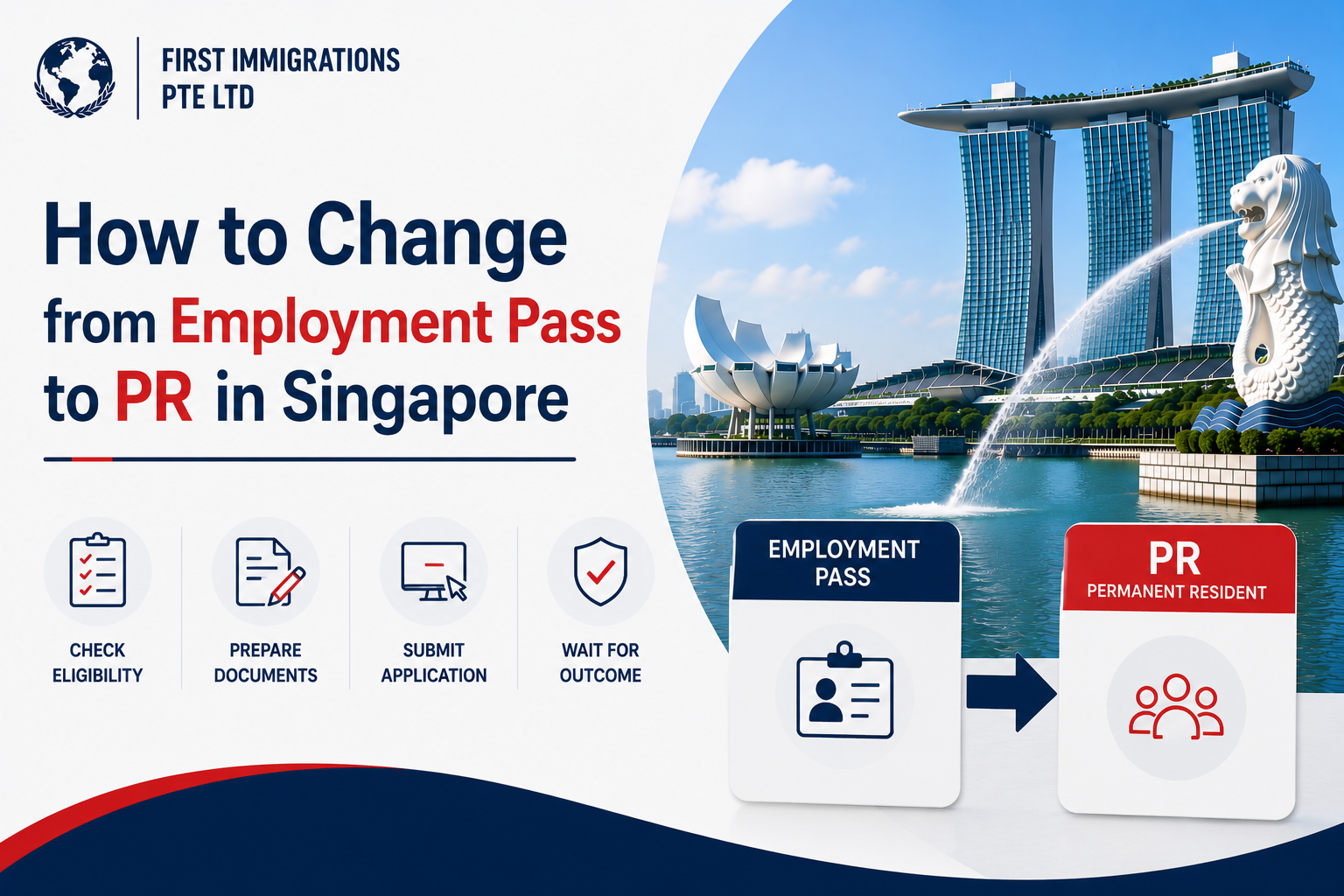
Moving from an Employment Pass to Singapore PR is the goal for many professionals here, and EP holders are among the strongest PR candidates. But you do not “convert” an EP into PR; you apply for PR under the PTS scheme while holding your EP. This guide explains how the EP to PR move works, when to apply, and how to give yourself the best chance.
Quick answer: You cannot directly convert an Employment Pass to PR. Instead, while working on your EP, you apply for PR online through ICA under the PTS scheme. You can technically apply after about six months, but most successful EP holders apply after two to three years of stable employment. EP holders are strong candidates because a good salary and skilled role weigh heavily in ICA’s assessment. Processing takes around six months, and the S$100 fee applies per applicant.
Can you convert an Employment Pass to PR?
Not directly. There is no “EP to PR conversion”. What happens is that an EP holder applies for Permanent Residence under the Professionals, Technical Personnel and Skilled Workers (PTS) scheme, while continuing to work on their EP. If approved, you become a PR and no longer need the EP.
The good news is that EP holders are among the strongest PR applicant profiles. The EP already signals a professional-level salary and skill set, which are exactly the things ICA weighs most. For how the scheme works, see our guide on the PTS scheme for PR.
When should EP holders apply?
Timing is one of the biggest levers you control.
- The minimum. ICA generally allows applying after about six months on your EP.
- What works. Most successful EP holders apply after two to three years of continuous employment, which shows stable income, tax, and commitment.
- Salary. Your EP should comfortably meet the qualifying salary, currently from S$5,600 a month (S$6,200 in financial services, rising in January 2027), and you should score well on COMPASS. A salary that is strong for your role and age helps your PR case too.
Applying in your first year, with a thin track record, is one of the most common reasons EP holders are rejected.
Why EP holders are strong PR candidates
ICA assesses PR holistically, and an EP holder typically ticks several boxes at once:
- A professional salary and a skilled role, showing economic contribution.
- A recognised employer and sector, often in areas Singapore values.
- Qualifications that meet EP standards.
- A track record of tax and CPF-free work that becomes CPF-paying once you are a PR.
The stronger and more stable this profile, the better your chances. A rising salary beats a flat one, and a settled role beats frequent job-hopping.
Step by step: EP to PR
You apply online; there is no separate “conversion” process.
|
Step |
What you do |
|
1. Confirm you are ready |
Check your salary, tenure, and profile strength |
|
2. Prepare documents |
Passport, EP, payslips, employer letter, certificates |
|
3. Log in to ICA e-PR |
Use your Singpass |
|
4. Complete the form and upload |
Within the 7-day window |
|
5. Pay the fee |
S$100 per applicant |
|
6. Wait for the outcome |
Around 6 months, sometimes longer |
You can include your spouse and unmarried children under 21 in the same application. For the full checklist, see our guide on PR application requirements, and for the wider process, how to apply for Singapore PR.
Documents you need
|
Document |
Notes |
|
Passport |
Biodata page, with old passports if any |
|
Employment Pass |
Your current EP |
|
Employer letter |
Dated within 3 months, with job title, start date, and salary |
|
Payslips |
Last six months |
|
Educational certificates |
Degrees and transcripts |
|
Recent photo |
To ICA specifications |
|
Family documents |
Marriage and birth certificates, if applying with family |
Non-English documents need official, notarised translations.
What changes once you get PR
Becoming a PR removes the constraints of the EP and adds real benefits:
- No more EP renewals or dependence on a single employer.
- Freedom to change jobs without a new pass, and no levy or quota attached to you.
- CPF, with employer contributions, phased in over your first years. See our guide on CPF for PRs.
- Resale HDB eligibility (after three years) and much lower property stamp duty.
- Family sponsorship and a pathway to citizenship.
Our guide on Singapore PR benefits covers these in full.
Common reasons EP holders are rejected
- Too little local work history, applying too early.
- A salary that is low for the role or not progressing.
- A weak employer profile or frequent job changes.
- Incomplete or inconsistent documents.
- Little evidence of long-term commitment or integration.
If a past application was unsuccessful, our guide on what to do after a PR rejection explains your options.
How to strengthen your EP to PR application
- Apply at two to three years, not year one.
- Show salary progression, not a flat income.
- Stay with a stable employer rather than job-hopping near application time.
- Build documented integration in the community.
- Apply with family where relevant, to signal a settled life here.
Our PR application tips go deeper.
How First Immigration can help
The EP to PR move is where good timing and presentation matter most. First Immigration helps you:
- Judge whether you are ready to apply or should wait.
- Present your salary, role, and stability the way ICA weighs them.
- Prepare a complete, competitive application.
- Plan the path from EP to PR and, later, to citizenship.
Speak to our consultants through the contact page.
Frequently asked questions
Can I convert my Employment Pass to PR?
Not directly. You apply for PR under the PTS scheme while holding your EP. If approved, you become a PR and no longer need the EP.
How long should I hold an EP before applying for PR?
ICA allows applying after about six months, but most successful applicants apply after two to three years of stable employment.
Are EP holders good PR candidates?
Yes. EP holders are among the strongest applicants because a professional salary and skilled role weigh heavily in ICA’s holistic assessment.
What salary do I need to apply for PR on an EP?
There is no fixed PR salary cut-off, but your EP should meet the qualifying salary (from S$5,600, or S$6,200 in financial services) and you should score well on COMPASS.
How do I apply for PR as an EP holder?
Apply online through the ICA e-PR portal with Singpass, complete the form, upload your documents within the 7-day window, and pay the S$100 fee.
How long does an EP to PR application take?
Around six months on average, though complex cases can take longer. ICA does not give progress updates.
What happens to my EP after I get PR?
You no longer need it. As a PR you can work and change jobs freely without a work pass.
Why do EP holders get rejected for PR?
Usually for applying too early, a salary that is low or not progressing, a weak employer profile or job-hopping, incomplete documents, or weak evidence of long-term commitment.