If you have just become a Permanent Resident, CPF will change your payslip. Yes, PRs contribute to CPF, but not at the full rate straight away. This guide explains the CPF contribution rates for Singapore PR holders in 2026, how the graduated first two years work, what employers must do, and how it affects your take-home pay.
Quick answer: Yes, PRs have CPF, and it starts as soon as you become a PR. For those aged 55 and below, contributions are phased in: in Year 1 the employee pays 5% and the employer 4% (9% total), in Year 2 it rises to 15% + 9% (24%), and from Year 3 it reaches the full 20% + 17% (37%), the same as citizens. You can jointly opt in to full rates earlier. CPF applies to wages above S$50, up to a monthly ceiling (S$8,000 from 2026).
Do PRs contribute to CPF?
Yes. CPF (the Central Provident Fund) is Singapore’s mandatory savings scheme for retirement, healthcare, and housing, and it applies to PRs just as it does to citizens. The moment your PR status takes effect, CPF contributions begin on your salary, split between you and your employer.
The one difference from citizens is timing: new PRs pay lower, graduated rates for the first two years before moving to full rates, to ease the adjustment to a smaller take-home pay.
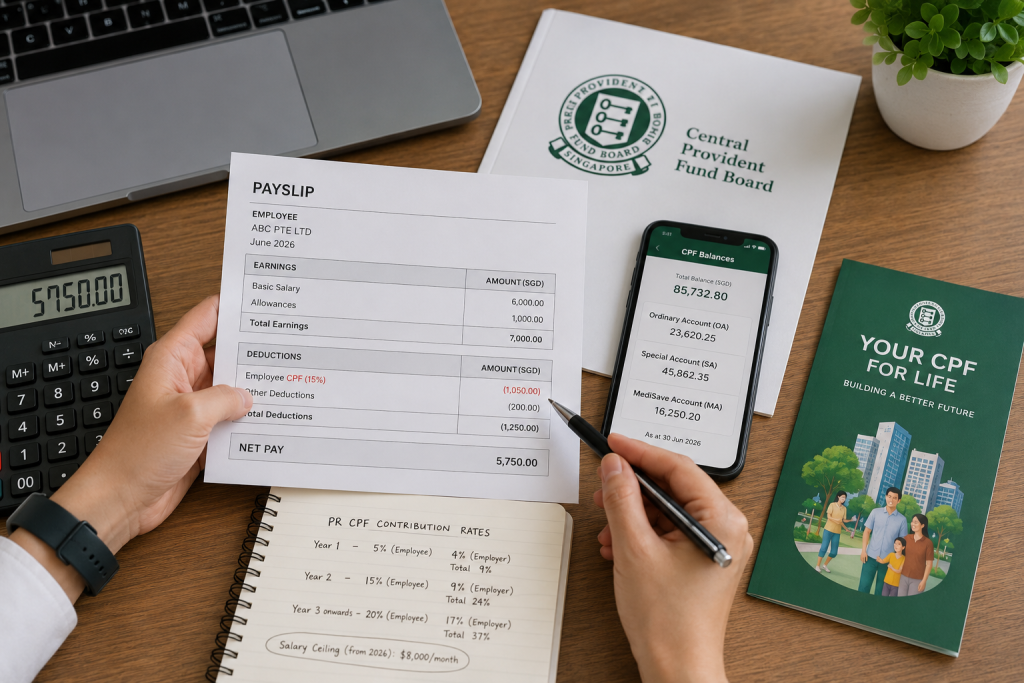
PR CPF contribution rates (age 55 and below)
For employees aged 55 and below, the rates phase in over three years.
| PR year | Employee | Employer | Total |
| Year 1 | 5% | 4% | 9% |
| Year 2 | 15% | 9% | 24% |
| Year 3 onwards | 20% | 17% | 37% |
“Year 1” runs from the date you obtain PR, and the rate steps up on each anniversary. From the third year, your CPF is identical to a citizen’s. Rates for older age bands are lower and differ; the table above covers the majority of working PRs.
Why the graduated rates, and can you skip them?
The lower first- and second-year rates cushion the drop in take-home pay when you become a PR. But they are optional in one direction:
- You can opt in to full rates early. Both employer and employee can jointly apply to contribute at full rates from the start. An employee can also choose to pay the full employee share while the employer stays on the graduated rate.
- Why do it? Higher contributions mean more going into your CPF (for housing, retirement, and healthcare) sooner, though less cash in hand now.
Year by year
- Year 1 (9% total). The gentlest phase. A modest 5% comes off your pay, with the employer adding 4%.
- Year 2 (24% total). The step up is significant, from 5% to 15% on the employee side. This is the year most PRs feel the change in take-home pay, so plan for it.
- Year 3 onward (37% total). You are now on full rates, the same as a citizen, with 20% from you and 17% from your employer.
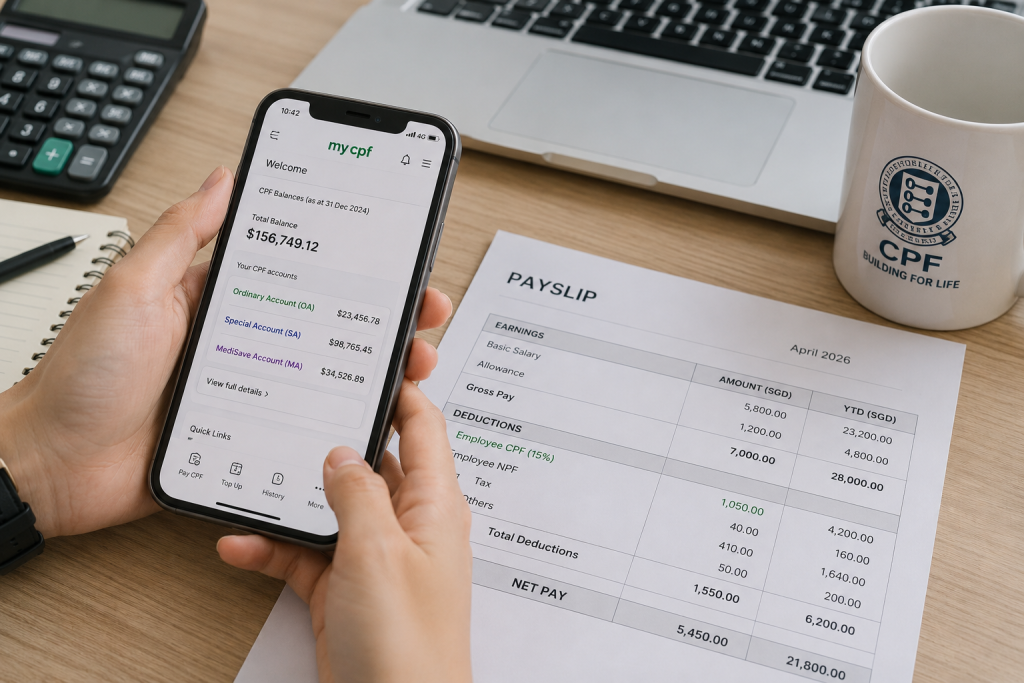
Where your CPF goes: the three accounts
Your contributions are split across three accounts:
- Ordinary Account (OA): for housing, and some investment.
- Special Account (SA): for retirement savings.
- MediSave Account (MA): for healthcare and approved insurance.
This is how CPF builds a housing and retirement fund you would not have as a foreigner. See our guide on Singapore PR benefits.
Salary ceiling and minimum
- Minimum. CPF applies to wages above S$50 a month; the full employee share applies once wages exceed S$750.
- Ceiling. Contributions apply up to the CPF monthly salary ceiling, which rises to S$8,000 from 2026 under the phased increases. Salary above the ceiling does not attract CPF. Confirm the current figure with the CPF Board.
Impact on your take-home pay
The jump from Year 1 to Year 3 is real. As your employee contribution rises from 5% to 20%, more of your salary is diverted into CPF, so your cash take-home falls even though your total compensation (including the employer’s share) rises. The money is not lost, it is saved for your housing, retirement, and healthcare, but budget for the lower cash amount, especially in Year 2 when the rate jumps most.
Employer obligations for PR CPF
If you employ a PR, CPF is mandatory and time-bound:
- Contribute from day one of PR status, at the correct graduated rate for the employee’s PR year and age.
- Pay by the 14th of the following month.
- Apply the anniversary rate changes on time; a common error is missing the step-up date.
- Late or short payments attract interest and penalties, so keep records accurate.
Common CPF mistakes for PRs and employers
- Missing the anniversary step-up, leaving a PR on Year 1 rates into Year 2.
- Ignoring the salary ceiling, over- or under-contributing.
- Forgetting CPF starts immediately on PR approval, not later.
- Poor communication about the take-home pay drop, which surprises new PRs.
How First Immigration can help
CPF is one of the practical realities of becoming a PR, and it is worth understanding before you take the step. First Immigration helps you:
- Understand how PR changes your finances, including CPF.
- Assess your eligibility and prepare a strong PR application.
- Plan the path from work pass to PR and, later, citizenship.
See our guides on how to apply for Singapore PR and PR vs citizen, or speak to our consultants through the contact page.
Frequently asked questions
Do Singapore PRs have to contribute to CPF?
Yes. CPF is mandatory for PRs and starts as soon as your PR status takes effect, with contributions from both you and your employer.
What are the CPF contribution rates for PRs?
For those aged 55 and below: Year 1 is 5% employee and 4% employer (9%), Year 2 is 15% and 9% (24%), and Year 3 onwards is the full 20% and 17% (37%).
Why is my CPF lower in the first two years of PR?
New PRs pay graduated (lower) rates for the first two years to ease the transition, before moving to full rates in the third year.
Can I pay full CPF rates from the start?
Yes. Employer and employee can jointly apply for full rates immediately, or the employee can choose to pay the full employee share early.
When do full CPF rates apply for a PR?
From the third year of PR status, when rates match a Singapore citizen’s.
What is the CPF salary ceiling for PRs?
The same as for citizens: contributions apply up to the monthly salary ceiling, which rises to S$8,000 from 2026. Salary above the ceiling does not attract CPF.
How does CPF affect my take-home pay as a PR?
Your cash take-home falls as your employee contribution rises from 5% to 20% over three years, though the money is saved in your CPF accounts for housing, retirement, and healthcare.
When must employers pay CPF for a PR?
From day one of PR status, by the 14th of the following month, at the correct graduated rate. Late payment attracts interest and penalties.
Which CPF accounts does my contribution go to?
Your Ordinary Account (housing), Special Account (retirement), and MediSave Account (healthcare).