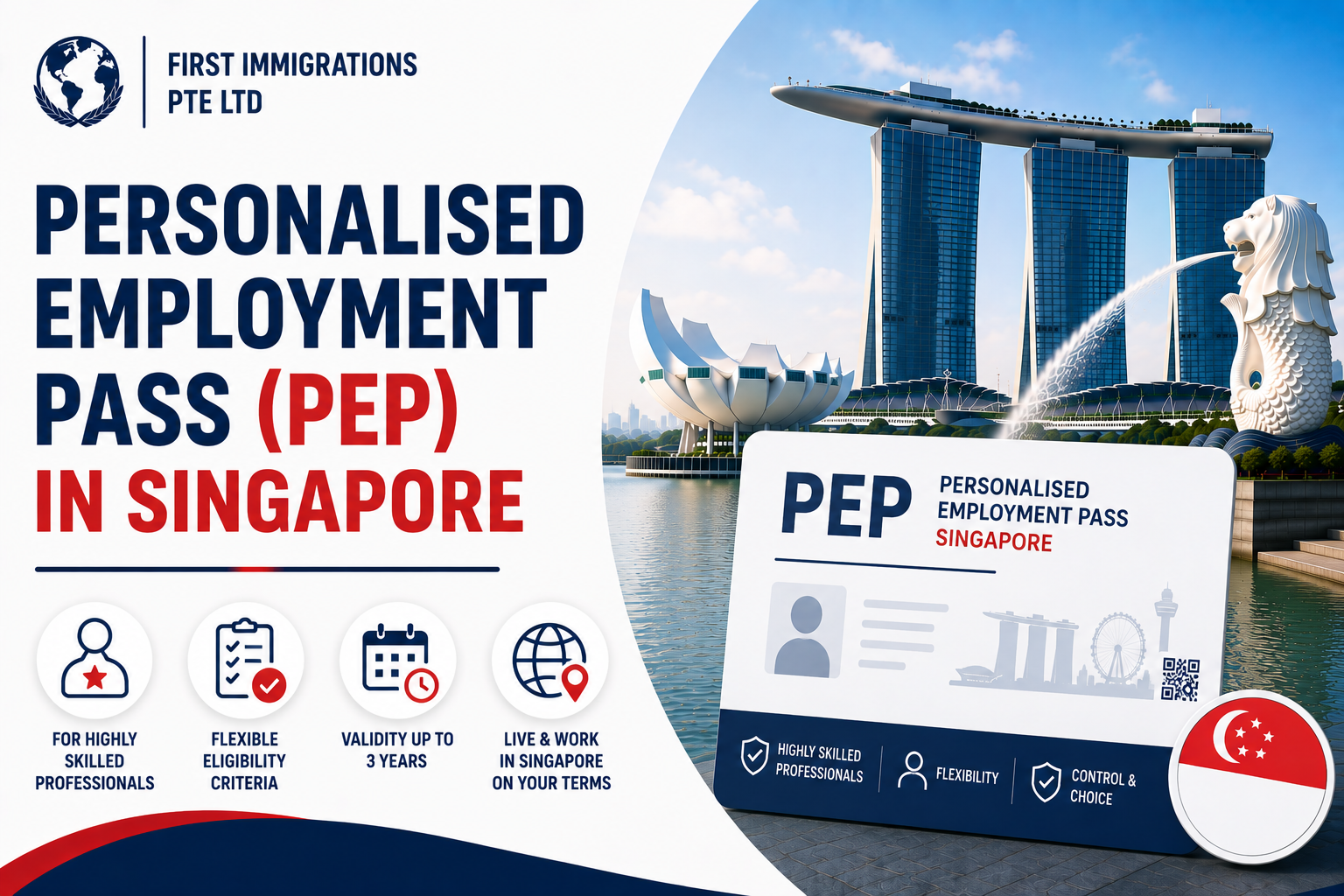
The Personalised Employment Pass (PEP) is Singapore’s work pass for high-earning professionals who want freedom from a single employer. Unlike a standard Employment Pass, it is not tied to a company, so you can change jobs or take a break without reapplying. This guide explains who qualifies, what you must keep earning, the rules, and how it compares to an EP.
Quick answer: The PEP is for top-tier professionals. You qualify if you are an existing Employment Pass holder earning at least S$22,500 a month, or an overseas professional whose last drawn fixed monthly salary was at least S$22,500 in the six months before applying. It is not tied to an employer, but you must earn at least S$270,000 a year to keep it, cannot run a business on it, and it is a one-time, non-renewable pass valid for three years.
What is the Personalised Employment Pass?
The PEP is a premium work pass for high-earning professionals, managers, and executives. Its defining feature is flexibility: it is not tied to any employer. On a standard Employment Pass, changing jobs means your new employer must apply for a fresh pass. On a PEP, you keep the same pass across jobs, and can even take time between roles.
That freedom comes with strict income conditions and a few firm limits.
Who is eligible for a PEP?
You qualify through one of two routes:
- Existing EP holders earning a fixed monthly salary of at least S$22,500.
- Overseas professionals whose last drawn fixed monthly salary was at least S$22,500 in the six months immediately before the application.
Because the salary bar is so high, PEP holders are exempt from the COMPASS framework that applies to standard EPs.
The rules you must keep
The PEP is generous, but conditional. To hold onto it you must:
- Earn at least S$270,000 a year in fixed salary, regardless of how many months you actually work.
- Be employed for at least 6 months in each calendar year.
- Notify MOM when you change jobs or become unemployed.
Miss the income or employment conditions and the pass can be cancelled.
What you cannot do on a PEP
- You cannot start or run a business. The PEP is for employment only; you cannot be self-employed. Entrepreneurs should look at the EntrePass instead.
- You cannot renew it. The PEP is a once-in-a-lifetime, non-renewable pass valid for three years. When it ends, to keep working in Singapore you move to a standard Employment Pass or another pass.
PEP vs Employment Pass
|
Employment Pass |
Personalised Employment Pass |
|
|
Tied to an employer |
Yes |
No |
|
Salary needed |
From S$5,600 (rising with age) |
S$22,500/month; S$270,000/year to maintain |
|
Change jobs |
New EP each time |
Keep the same pass |
|
Run a business |
No |
No |
|
COMPASS |
Yes |
Exempt |
|
Validity |
Up to 2 years (3 on renewal) |
3 years, non-renewable |
For the standard pass, see our guide on Employment Pass eligibility.
Does a PEP lead to PR?
Like other work passes, a PEP holder can apply for Singapore PR under the PTS scheme. A PEP signals a high salary and strong professional standing, which are exactly what ICA weighs, so PEP holders are typically strong PR candidates. Given the PEP cannot be renewed, many holders plan their PR application within its three-year window. See our guide on how to apply for Singapore PR.
How First Immigration can help
The PEP has valuable freedoms but unforgiving conditions, and it does not renew. First Immigration helps you:
- Confirm whether you qualify and whether the PEP or a standard EP suits you.
- Manage the salary and employment conditions correctly.
- Plan your PR application within the PEP’s three-year window.
Speak to our consultants through the contact page.
Frequently asked questions
What is the Personalised Employment Pass?
A premium work pass for high earners that is not tied to an employer, letting you change jobs or take a break without reapplying.
Who qualifies for a PEP?
Existing EP holders earning at least S$22,500 a month, or overseas professionals whose last drawn fixed monthly salary was at least S$22,500 in the six months before applying.
How much must I earn to keep a PEP?
At least S$270,000 a year in fixed salary, and you must be employed for at least six months each calendar year.
Can I start a business on a PEP?
No. The PEP is for employment only. Entrepreneurs should consider the EntrePass.
Is the PEP renewable?
No. It is a once-in-a-lifetime, non-renewable pass valid for three years. After that you move to another pass.
Is a PEP holder exempt from COMPASS?
Yes. Because of the high salary threshold, PEP holders are not assessed under COMPASS.
Can a PEP holder apply for PR?
Yes, under the PTS scheme. A PEP’s high salary makes for a strong PR profile, and many apply within the pass’s three-year validity.
What happens when my PEP expires?
It cannot be renewed. To keep working in Singapore, you apply for a standard Employment Pass or another suitable pass.