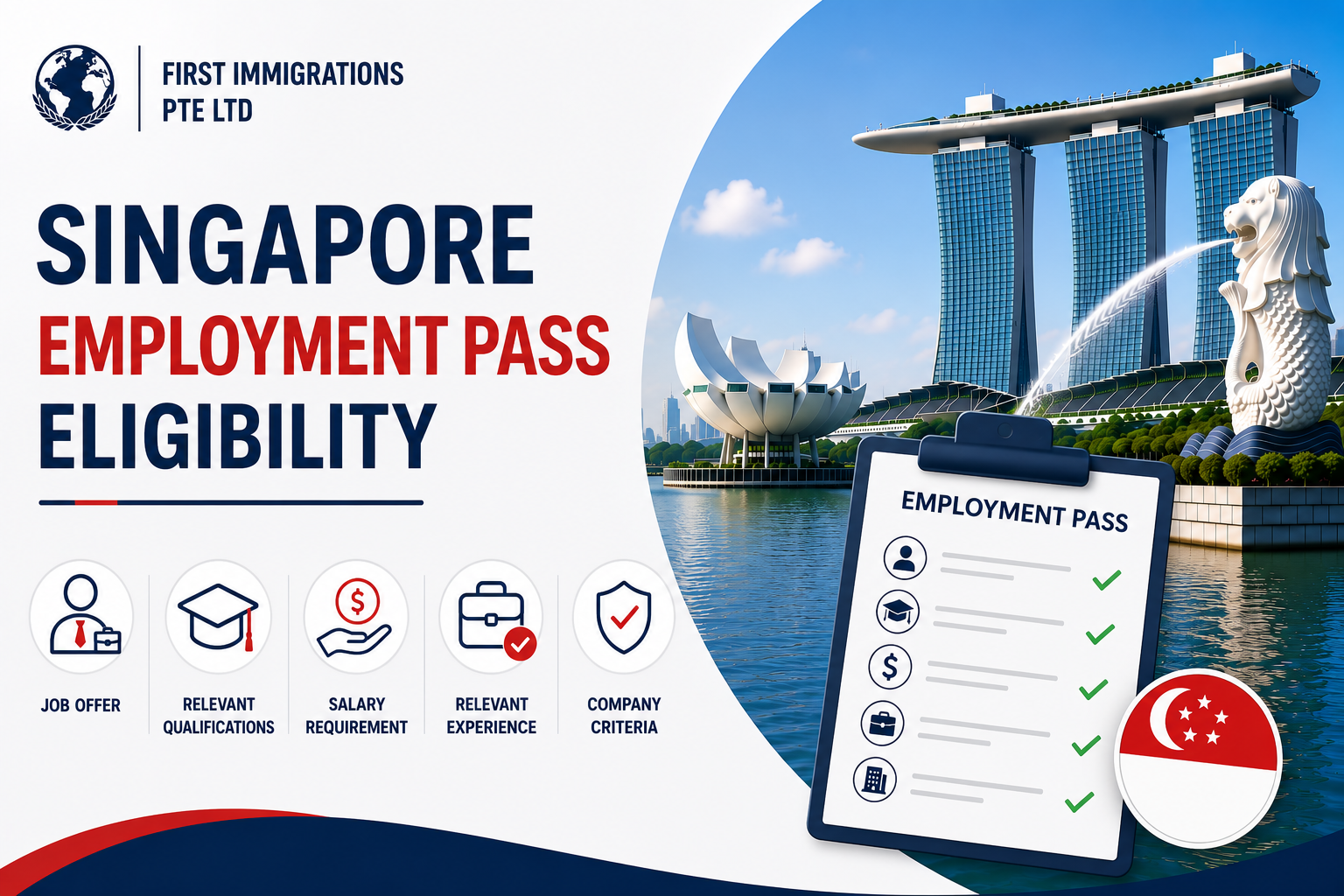
The Employment Pass (EP) is Singapore’s work pass for foreign professionals, managers, and executives, and in 2026 it is harder to qualify for than it used to be. Eligibility now rests on two things: meeting the minimum qualifying salary, and passing the COMPASS points framework. This guide explains EP eligibility in full, so you know whether you or your hire will qualify.
Quick answer: To be eligible for a Singapore Employment Pass in 2026, the candidate must earn at least the minimum qualifying salary (from S$5,600 a month, or S$6,200 in financial services, rising with age), hold acceptable qualifications, and pass the COMPASS framework with at least 40 points. Candidates earning S$22,500 a month or more are exempt from COMPASS. The EP is also the strongest foundation for a later Singapore PR application.
Who is the Employment Pass for?
The EP is for foreign professionals, managers, executives, and technicians (PMETs) taking up skilled jobs in Singapore. It is employer-sponsored and sits at the top of the work-pass ladder, above the S Pass (mid-skilled) and Work Permit (semi-skilled). For how the passes compare, see our guide on the Employment Pass and S Pass.
Requirement 1: the minimum qualifying salary
The EP has an age-based minimum salary. Older, more experienced candidates must earn more, because the salary is benchmarked against local professionals at the same age.
|
Candidate |
General sectors |
Financial services |
|
Younger applicant (entry) |
From S$5,600 |
From S$6,200 |
|
Around age 45 and above |
S$10,700 |
S$11,800 |
These are the minimums to be considered; a competitive COMPASS score usually needs more. The salary floors are also scheduled to rise again from January 2027 (to S$6,000 general and S$6,600 financial services for entry-level). Always confirm current figures with MOM.
Requirement 2: passing COMPASS
Since 2023, most EP applications must also pass COMPASS (the Complementarity Assessment Framework), a points system. You need at least 40 points to pass.
COMPASS scores four foundational criteria (each worth 0, 10, or 20 points) plus two bonus criteria.
|
Criterion |
What it measures |
Points |
|
C1 Salary |
Your salary vs local PMET salaries in the sector |
0 / 10 / 20 |
|
C2 Qualifications |
Your degree and the institution’s standing |
0 / 10 / 20 |
|
C3 Diversity |
Share of your nationality among the firm’s PMETs |
0 / 10 / 20 |
|
C4 Support for locals |
The firm’s share of local PMETs vs its industry |
0 / 10 / 20 |
|
C5 Skills bonus |
Job on the Shortage Occupation List |
0 / 20 |
|
C6 Strategic priorities |
Firm’s contribution to Singapore’s priorities |
0 / 10 |
For the C1 salary criterion, you earn 10 points at the 65th percentile of local PMET salaries and 20 points at the 90th percentile. Note that two of the criteria (C3 and C4) are about your employer, not you, so the same candidate can score differently at different companies.
Updated COMPASS rules take effect for new applications from 1 January 2026 (and renewals from mid-2026), so check the latest criteria before applying.
Who is exempt from COMPASS?
You do not need to pass COMPASS if:
- The candidate earns a fixed monthly salary of S$22,500 or more.
- The candidate is an intra-corporate transferee, or the role is being filled for a short period.
Everyone else below the S$22,500 threshold is scored.
Requirement 3: qualifications
The candidate should hold acceptable qualifications, typically a good university degree, and ideally from a well-regarded institution, which also feeds the C2 COMPASS score. Strong professional qualifications and relevant experience support the application.
The EP as a path to PR
Beyond letting you work, the EP is the strongest foundation for Permanent Residence. EP holders apply for PR under the PTS scheme, and a professional salary and skilled role weigh heavily in ICA’s assessment. Most apply after two to three years. See our guides on Employment Pass to PR and the PTS scheme.
Common reasons an EP is refused
- Salary below the qualifying minimum for the candidate’s age or sector.
- A COMPASS score under 40, often due to firm-level factors (low diversity or weak local support).
- Qualifications that do not meet the bar or are from unrecognised institutions.
- An incomplete or inconsistent application.
How First Immigration can help
EP eligibility has become more demanding, and firm-level COMPASS factors are easy to overlook. First Immigration helps you:
- Check a candidate against the salary and COMPASS requirements.
- Identify weak spots, including employer-side COMPASS factors.
- Prepare a clean application, and plan ahead toward PR.
Explore our Employment Pass service, or speak to our consultants through the contact page.
Frequently asked questions
What is the minimum salary for an Employment Pass in Singapore?
From S$5,600 a month for younger candidates in general sectors (S$6,200 in financial services), rising with age to S$10,700 (general) or S$11,800 (financial services) at 45 and above. Floors rise again from January 2027.
What is COMPASS for the Employment Pass?
COMPASS is the points framework used to assess EP eligibility. You need at least 40 points across salary, qualifications, firm diversity, support for local employment, and two bonus criteria.
How many points do I need to pass COMPASS?
At least 40 points. The four foundational criteria each award up to 20 points, with two bonus criteria on top.
Who is exempt from COMPASS?
Candidates earning a fixed monthly salary of S$22,500 or more, intra-corporate transferees, and roles filled for a short period.
Does my employer affect my EP eligibility?
Yes. Two COMPASS criteria (diversity and support for local employment) are about the employer, so the same candidate can score differently at different firms.
What qualifications do I need for an EP?
Typically a good university degree, ideally from a well-regarded institution, which also improves your COMPASS qualifications score.
Is it getting harder to qualify for an EP?
Yes. Rising salary floors and the COMPASS framework, with updates from 2026, have made EP eligibility more demanding than in the past.
Can an EP holder apply for PR?
Yes. The EP is the strongest foundation for a PR application under the PTS scheme, usually after two to three years of employment.