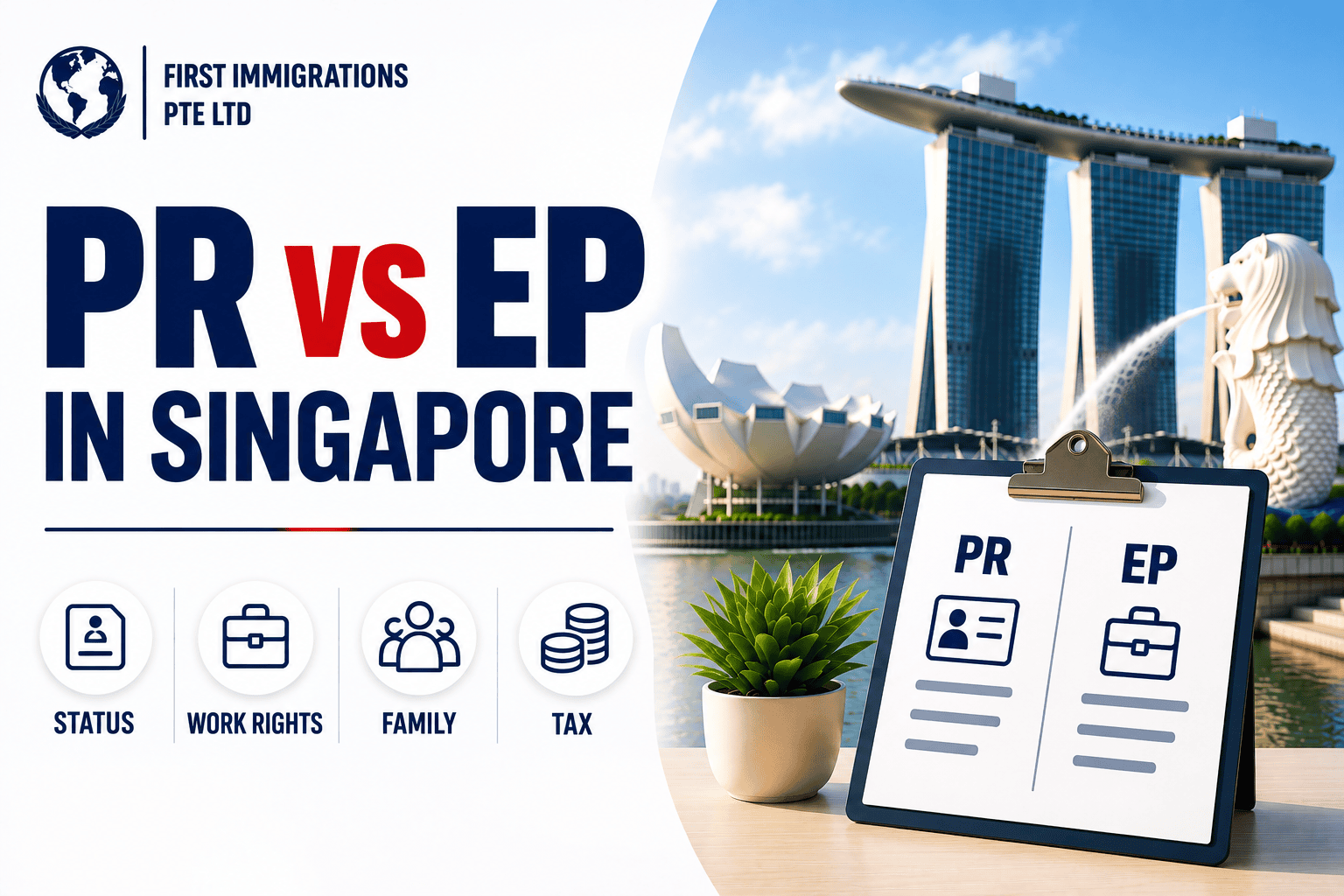
Many professionals on an Employment Pass wonder whether it is worth applying for PR. The two are very different: an EP is a temporary work pass tied to your employer, while Singapore PR is permanent status you hold in your own right. This guide compares PR vs EP in 2026, the benefits, the trade-offs, and who should make the move.
Quick answer: An Employment Pass lets you work for one employer and expires; a PR is permanent, lets you change jobs freely, and adds CPF, resale HDB eligibility, far lower property stamp duty, subsidised healthcare and schooling, family sponsorship, and a path to citizenship. The trade-offs of PR are CPF contributions (lower take-home), National Service for second-generation sons, and needing a Re-Entry Permit. For those staying long term, PR is usually worth it.
The core difference
- Employment Pass (EP): a temporary work pass, tied to a specific employer. Change jobs and your new employer must apply for a new EP. It expires and must be renewed, and depends on meeting the salary and COMPASS rules each time.
- Permanent Residence (PR): permanent status held in your own right, not tied to an employer. You can work and change jobs freely, and it unlocks benefits an EP does not.
PR vs EP at a glance
| Feature | Employment Pass | Permanent Resident |
| Nature | Temporary work pass | Permanent status |
| Tied to employer | Yes | No |
| Change jobs | New EP each time | Freely, no new pass |
| CPF | No | Yes, with employer contributions |
| Resale HDB | Not eligible | Eligible after 3 years |
| Property stamp duty (ABSD) on first home | 60% (as a foreigner) | 5% |
| Healthcare subsidies | Limited | Yes (below citizen level) |
| Children’s school fees | Higher (foreigner rates) | Lower PR rates |
| Family | Dependant’s Pass if salary qualifies | Can sponsor family for PR |
| Duration | Up to 2 years (3 on renewal) | Permanent (with Re-Entry Permit) |
| Path to citizenship | No | Yes, after 2 years |
Why upgrade from EP to PR
- Job freedom. No more tying your stay to one employer, or reapplying when you switch.
- CPF savings, with employer contributions building a housing and retirement fund.
- Housing. Buy a resale HDB flat and pay 5% ABSD instead of a foreigner’s 60%, a saving that can run into tens of thousands.
- Cheaper healthcare and schooling for your family.
- A path to citizenship.
See our guide on Singapore PR benefits.
Reasons some stay on an EP
PR is not for everyone right now. You might hold off if:
- You want to keep your full take-home pay (PR means CPF contributions come out of your salary).
- You have sons and want to weigh National Service, which applies to second-generation male PRs.
- You are not sure you will stay long term, and prefer the flexibility of a pass you can simply let lapse.
- Your profile is not yet competitive for PR, in which case waiting and strengthening it is wiser.
See our guide on PR disadvantages for the full trade-offs.
Who should get PR?
If you plan to stay in Singapore several years, want to buy property, are raising a family here, or are thinking about citizenship, PR usually pays off. EP holders are also among the strongest PR candidates, so a stable, well-paid EP profile is a good base. If you are early in your stay or unsure, staying on the EP a little longer is reasonable.
How to move from EP to PR
You do not “convert” an EP; you apply for PR under the PTS scheme while holding your EP, usually after two to three years. See our guide on Employment Pass to PR and how to apply for Singapore PR.
How First Immigration can help
Deciding between staying on an EP and applying for PR is a personal, financial decision. First Immigration helps you:
- Weigh PR against your EP for your situation.
- Judge whether your profile is ready to apply.
- Prepare a strong PR application.
For the pass itself, see our Employment Pass service, or speak to our consultants through the contact page.
Frequently asked questions
What is the difference between PR and an Employment Pass?
An EP is a temporary work pass tied to one employer that expires; PR is permanent status held in your own right, with CPF, housing, healthcare, and family benefits an EP does not have.
Is it worth getting PR if I have an EP?
For those staying long term, usually yes. PR adds job freedom, CPF, resale HDB, much lower stamp duty, and a path to citizenship. The trade-offs are CPF contributions, NS for sons, and needing a Re-Entry Permit.
Can I change jobs more easily as a PR?
Yes. A PR changes jobs freely without a new pass. An EP holder needs a new EP for each employer.
Does becoming a PR reduce my take-home pay?
Yes, initially, because CPF contributions come out of your salary (phased in over the first two years). The money is saved for housing, retirement, and healthcare.
Do EP holders pay CPF?
No. Only citizens and PRs contribute to CPF. This is one reason take-home falls after becoming a PR.
Can I buy property more cheaply as a PR?
Yes. A PR pays 5% ABSD on a first home versus a foreigner’s 60%, and can buy a resale HDB flat after three years.
How do I go from EP to PR?
Apply for PR under the PTS scheme while holding your EP, usually after two to three years of stable employment.
Do PR children have to do National Service?
Second-generation male PRs (granted PR as children) are liable for NS, which EP holders’ children are not.