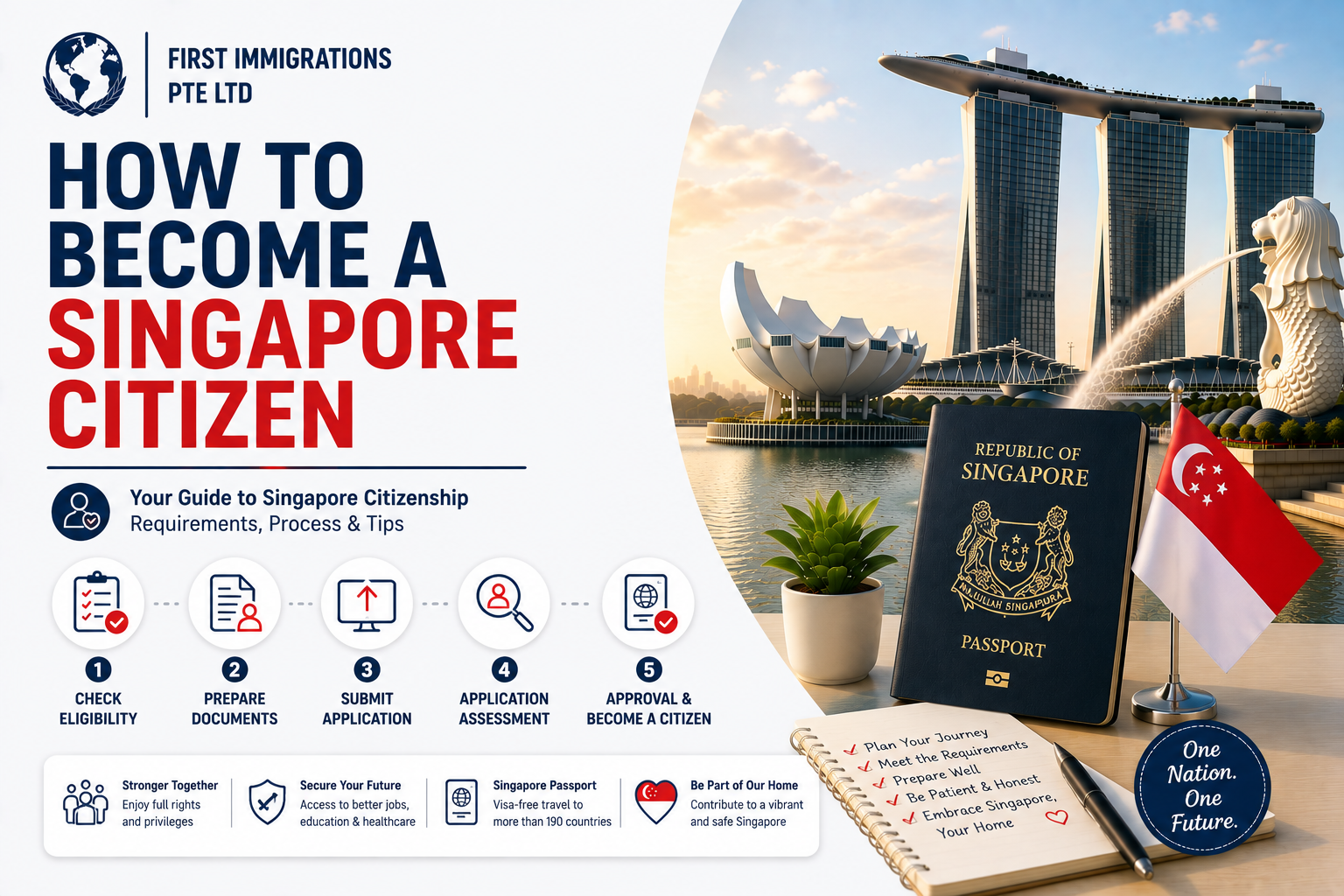
Quick answer: Most people become Singapore citizens by first holding Singapore PR for at least 2 years, then applying to ICA online with Singpass. ICA’s roadmap has four stages: online application (general processing time 12 months), in-principle approval and the Singapore Citizenship Journey (about 2 months, for applicants aged 16 to 60), renunciation of foreign citizenship and registration at the ICA Building, and a citizenship ceremony usually held 3 to 6 months after registration. The application fee is S$100, plus S$70 for the certificate and S$10 for the identity card.
Singapore does not grant citizenship automatically after a set number of years. Every application is assessed on its merits, and approval is discretionary. What you can control is the timing, the completeness of the file and how well you prepare for the steps after approval, especially giving up your current nationality.
This guide follows ICA’s official citizenship roadmap stage by stage. If you would like your eligibility and documents checked before you submit, our Singapore citizenship application service handles the full process.
The citizenship roadmap at a glance
| Stage | What happens | Time |
| 1. Online application | Submit the application and documents on ICA e-Service | General processing time: 12 months |
| 2. In-principle approval (IPA) | Download the IPA letter and complete the Singapore Citizenship Journey (ages 16 to 60) | About 2 months |
| 3. Approval letter and registration | Download the letter to renounce foreign citizenship, renounce it (if 21 or older), then attend a registration appointment at ICA | Depends on your home country’s renunciation process |
| 4. Citizenship ceremony | Receive your citizenship certificate at a ceremony organised by your GRC or SMC | Usually 3 to 6 months after registration |
Source: ICA, Your Singapore Citizenship Roadmap.

How long does the whole process take?
Add the stages together and plan for a realistic range:
| Step | Estimate |
| ICA processing | about 12 months |
| Singapore Citizenship Journey | about 2 months |
| Renunciation and registration | varies by country, from weeks to several months |
| Wait for ceremony after registration | 3 to 6 months |
| Application to ceremony | roughly 18 months to 2 years or more |
ICA notes that some applications take longer than the general processing time. For children born overseas to Singapore citizens, processing is two months from receipt of complete documents.
Who can apply for Singapore citizenship?
ICA accepts applications under five main categories.
| Category | Key conditions | Who applies |
| Singapore PR | PR for at least 2 years and aged 21 or above. Can include a PR spouse and unmarried children under 21 | The PR |
| PR spouse of a Singapore citizen | Married to the citizen for at least 2 years and PR for at least 2 years | Citizen spouse sponsors |
| Child of a Singapore citizen | Unmarried, under 21, born within a legal marriage or legally adopted | Citizen parent sponsors |
| Student PR | Lived in Singapore at least 3 years (at least 1 year as PR), and passed a national exam (PSLE, GCE N, O or A Level) or is in the Integrated Programme | Applicant or parent |
| Aged parent of a Singapore citizen | Parent is a PR; citizen child aged 21 or above | Citizen child sponsors |
For the detailed requirements of each route, see our guide to Singapore citizenship requirements. If you are still a PR working towards the 2-year mark, our guide on moving from Singapore PR to citizenship covers timing.
What ICA considers
ICA says it looks at factors including:
- family ties to Singaporeans
- economic contributions
- qualifications
- age
- family profile
- length of residency
These are the same headline factors ICA uses for PR. There is no published points system or minimum salary. Our explainer on what ICA evaluates goes through each factor.
Before you apply: a checklist
- You meet the minimum PR period (usually 2 years from the date PR was granted)
- Your Re-Entry Permit is valid and you have lived in Singapore consistently
- Your documents, including your family’s, are ready with official translations where needed
- You understand that you must renounce your current citizenship if you are 21 or older
- You have checked National Service liability for yourself and your sons
- You have checked whether your home country has rules you must resolve before renouncing, such as property ownership
Stage 1: Submit the online application
- Log in to ICA e-Service with Singpass.
- Fill in your particulars. ICA asks for information on biodata, family, qualifications, employment and residency.
- Upload supporting documents using ICA’s document checklist. Our citizenship documents checklist explains what each item is for.
- Watch the deadlines. You have up to 7 days to fill in the particulars and upload documents, then up to another 7 days to review everything and pay.
- Set aside time. ICA estimates about 90 minutes per individual application.
- Pay the fee and keep the acknowledgement.
Fees
| Fee | Amount |
| Application fee | S$100 (S$18 for children born overseas to Singapore citizens) |
| Citizenship certificate | S$70 |
| Identity card (aged 15 and above) | S$10 |
All fees are non-refundable.
Stage 2: In-principle approval and the Singapore Citizenship Journey
If ICA approves your application in principle, you download an IPA letter. Applicants aged 16 to 60 must then complete the Singapore Citizenship Journey (SCJ), run by the Ministry of Culture, Community and Youth, ICA and the People’s Association.
| SCJ component | What it involves |
| e-Journey | An online module on Singapore’s shared values, citizens’ responsibilities, history, national symbols and systems |
| Singapore Experiential Visit | A half-day visit to landmarks and national institutions (or a half-day “Introduction to Service to Community” session) |
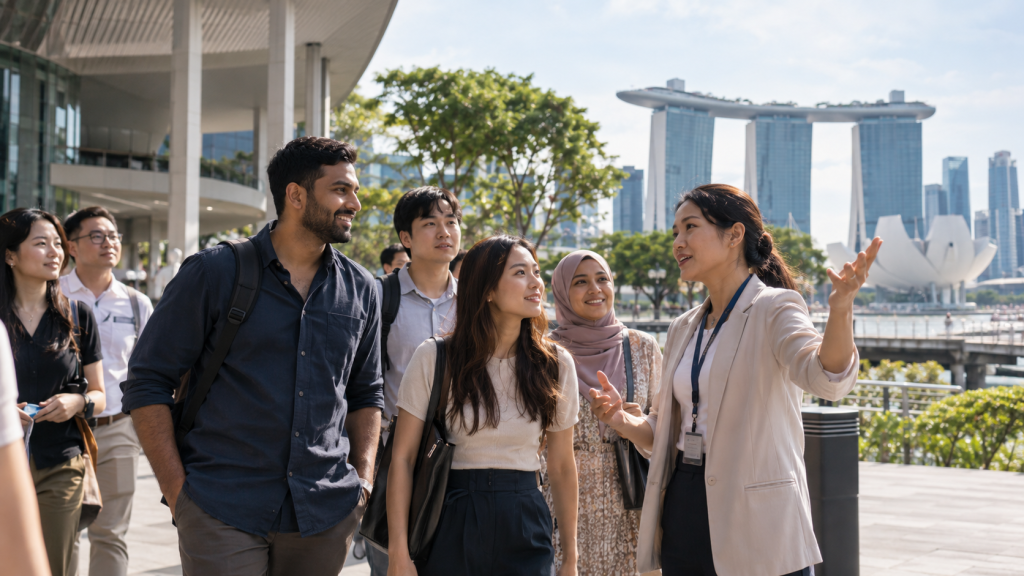
| Community Sharing Session | Meet residents and community volunteers from your constituency |
What to do:
- Log in to the SC Journey Portal 3 days after your IPA is issued.
- Complete the e-Journey.
- Book slots for the Experiential Visit and the Community Sharing Session early.
- Start preparing for renunciation now, because the next stage depends on it.
More detail is in our guide to the Singapore Citizenship Journey (SCJ).

Stage 3: Renounce your foreign citizenship and register
After the SCJ, you download a letter from ICA to renounce your foreign citizenship.
- Meet your home country’s renunciation requirements. ICA’s roadmap gives resolving property ownership issues as an example of what may be needed.
- Apply to renounce with your country’s embassy, high commission or authorities. This applies to applicants aged 21 and above.
- Prepare the registration documents listed in the annex ICA provides.
- Attend your registration appointment at the ICA Building on the scheduled date.
Renunciation rules and timelines differ widely between countries. Singapore does not allow adults to keep dual citizenship, which our article on whether Singapore allows dual citizenship explains. If you are Indian, our guide to Singapore citizenship for Indians covers the specific steps.
Stage 4: The citizenship ceremony
- The ceremony is usually held 3 to 6 months after you register as a citizen.
- It is organised by your Group Representation Constituency (GRC) or Single Member Constituency (SMC), which sends the invitation.
- You receive your Singapore citizenship certificate at the ceremony.
After you become a citizen
| Area | What changes |
| Identity documents | You receive a citizen identity card and can apply for a Singapore passport. See how to get a Singapore passport |
| Re-Entry Permit | No longer needed |
| National Service | Male citizens must serve NS unless exempted. Read our guide on National Service for PRs and their sons |
| Housing and stamp duty | Citizen rates and grants apply |
| Voting | You can vote in elections |
For the full list, see Singapore citizenship benefits and our comparison of Singapore PR vs citizen.
Common mistakes that delay citizenship
| Mistake | Effect | How to avoid it |
| Applying before the minimum PR period | Application cannot proceed | Count from the date PR was granted |
| Missing the 7-day draft or review windows | Draft is lost, start again | Prepare every document before logging in |
| Untranslated or unverified documents | Delays or requests for more information | Use official translations |
| Not planning renunciation early | Registration is delayed | Check your country’s rules during the SCJ stage |
| Missing SCJ slots | The journey takes longer than 2 months | Book sessions as soon as the portal opens |
| Ignoring NS liability for sons | Family plans change late in the process | Check NS rules before applying |
What if your application is not approved?
ICA does not publish detailed reasons for rejection. You can apply again later. Most people use the time to strengthen the factors ICA lists: a longer residency record, stable employment and income, and stronger family ties to Singapore. Our citizenship application service includes a review of past applications before you reapply.
How First Immigration can help
- Eligibility and timing check: we confirm which category you fall under and whether now is the right time to apply.
- Document preparation: we check every document and translation against ICA’s checklist.
- Family applications: we prepare applications that include your spouse and children.
- After IPA: we help you plan the SCJ, renunciation and registration steps so the process does not stall.
Learn more about our Singapore citizenship application service or book a free assessment through our contact page.
Frequently asked questions
How do I apply for Singapore citizenship?
Log in to ICA e-Service with Singpass, fill in your particulars, upload the documents on ICA’s checklist and pay the S$100 application fee. You have 7 days to complete the form and another 7 days to review and pay.
How long does a Singapore citizenship application take?
ICA’s general processing time is 12 months. After in-principle approval, the Singapore Citizenship Journey takes about 2 months, and the ceremony is usually 3 to 6 months after registration. Plan for around 18 months to 2 years from application to ceremony.
How many years of PR do I need before applying for citizenship?
Generally at least 2 years as a PR, and you must be 21 or above if applying on your own. A PR spouse of a citizen also needs at least 2 years of marriage.
How much does Singapore citizenship cost?
S$100 to apply (S$18 for children born overseas to citizens), S$70 for the certificate and S$10 for the identity card if you are 15 or older.
What is the Singapore Citizenship Journey?
A compulsory programme for new citizens aged 16 to 60 after in-principle approval. It has three parts: the online e-Journey, a Singapore Experiential Visit and a Community Sharing Session.
Do I have to give up my current citizenship?
Yes, if you are 21 or older. ICA issues a letter for you to renounce your foreign citizenship before you register as a Singapore citizen.
When is the citizenship ceremony?
Usually 3 to 6 months after you register as a citizen. Your GRC or SMC organises it and sends the invitation.
Can I become a Singapore citizen without being a PR first?
The main routes require PR status first. Children of Singapore citizens born overseas can apply as children of citizens.
Does ICA give reasons if my citizenship application is rejected?
ICA does not publish detailed reasons. You can reapply later after strengthening your profile.
Do new male citizens have to serve National Service?
Male citizens must serve NS unless exempted. Families with sons should check NS liability before applying.
Official sources: ICA, Becoming a Singapore Citizen and Your Singapore Citizenship Roadmap; Ministry of Culture, Community and Youth, Singapore Citizenship Journey.
Disclaimer: Processing times, fees and eligibility rules are based on ICA information as of September 2026 and may change. Citizenship approval is at ICA’s discretion and nothing in this article guarantees an outcome.