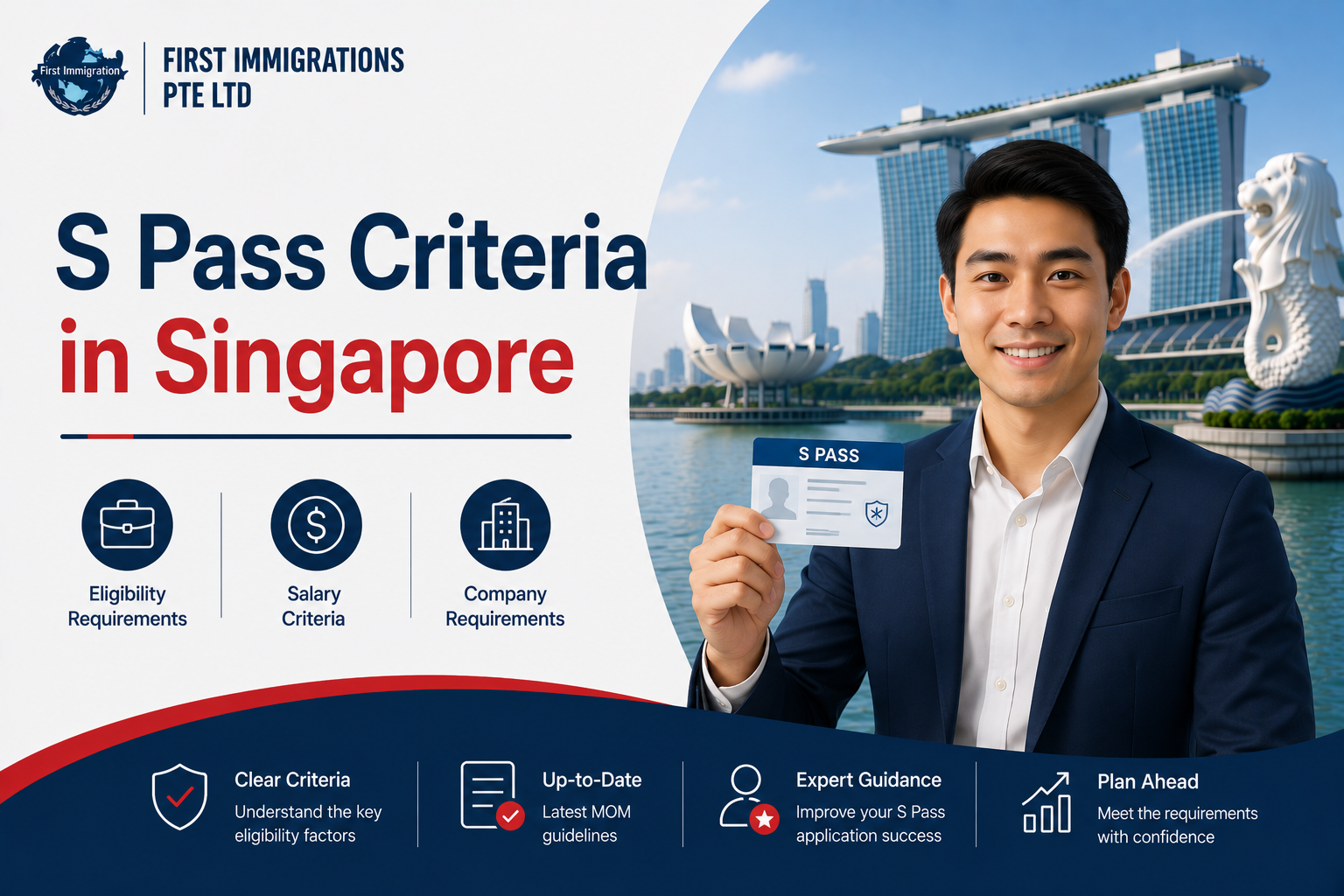
The S Pass is Singapore’s work pass for mid-skilled staff, and it comes with more conditions than the Employment Pass: a salary floor that rises with age, recognised qualifications, and employer-side rules on quota and levy. This guide sets out the full S Pass criteria for 2026 so both applicants and employers know exactly what it takes to qualify.
Quick answer: To qualify for an S Pass in 2026, the candidate needs a minimum qualifying salary (from S$3,300 a month for younger applicants, or S$3,800 in financial services, rising with age), a relevant degree, diploma, or technical qualification, and a job offer from a Singapore employer. The employer must have S Pass quota headroom and pay the S$650 monthly levy. Qualifying-salary thresholds are scheduled to rise, so check the current MOM figures before applying.
What is the S Pass?
The S Pass is an employer-sponsored work pass for mid-skilled workers in technical and supervisory roles, across sectors like engineering, IT, manufacturing, healthcare, and services. It sits between the Work Permit and the Employment Pass. Because it is tied to a specific employer and job, the company applies on the worker’s behalf and is responsible for meeting the quota and levy rules.
For how it compares to the professional-tier pass, see our guide on the Employment Pass and the S Pass, and learn more about our S Pass application service.
The core S Pass criteria at a glance
| Criterion | What is required |
| Minimum salary | Meets the qualifying salary for the candidate’s age (see below) |
| Qualifications | A relevant degree, diploma, or technical certificate |
| Work experience | Experience matching the role and pay |
| Job offer | From a registered Singapore employer who sponsors the pass |
| Employer quota | The company must be within its S Pass quota |
| Levy | The employer pays the monthly S Pass levy |
The first four are about the candidate; the last two are about the employer. Both sides must be satisfied.
1. Minimum qualifying salary
Salary is the criterion that trips most applicants. The S Pass minimum qualifying salary is benchmarked against local associate professionals and technicians, and it rises with age, so an older candidate must earn more to qualify.
As a guide for 2026:
| Candidate profile | Approx. minimum monthly salary |
| Younger applicant (general sector) | From S$3,300 |
| Younger applicant (financial services) | From S$3,800 |
| Around age 35 (general sector) | About S$4,100 |
| Around age 40 (general sector) | About S$4,500 |
| Mid-40s (general sector) | About S$5,100 |
These are indicative reference points; the exact figure depends on the candidate’s age and sector. The salary must also be paid in full monthly and reflect the role.
Scheduled increase: the qualifying salary is set to rise, with figures of S$3,600 (general) and S$4,000 (financial services) for younger applicants announced for new applications, and higher thresholds following for renewals. Because these thresholds move on a set schedule, always confirm the current numbers on the MOM website before you apply or renew.
2. Educational qualifications
The candidate needs a qualification relevant to the job. MOM generally accepts:
- A degree from a recognised, accredited university.
- A full-time diploma (a Singapore polytechnic diploma or an equivalent foreign qualification).
- A relevant technical or vocational certificate from an accredited institution.
The qualification should normally come from a full-time course and align with the role. Weak alignment between the qualification and the job is a common reason applications fail.
3. Relevant work experience
Beyond paper qualifications, MOM looks at whether the candidate’s experience fits the role and the salary offered. Solid, relevant experience strengthens an application, especially where it justifies a salary above the bare minimum.
4. Employer requirements: quota, levy, and LQS
Even a well-qualified candidate cannot get an S Pass if the employer has no room. Three employer-side rules apply.
Quota (Dependency Ratio Ceiling)
S Pass holders can only make up a set share of a company’s total workforce.
| Sector | S Pass quota (share of workforce) |
| Services | Up to 10% |
| Construction, Manufacturing, Marine Shipyard, Process | Up to 15% |
For a fuller breakdown of how the ceiling works, see our guide on the S Pass quota.
Levy
The employer pays a monthly foreign worker levy for each S Pass holder. This is now standardised at S$650 per month, and it cannot be deducted from the employee’s salary.
Local Qualifying Salary (LQS)
Quota headroom depends on how many local employees the company has, and locals only count if they are paid at least the LQS. From 1 July 2026, the LQS rises to S$1,800 a month for a full count. Locals paid below that count as only half a unit (or not at all), which shrinks the employer’s S Pass headroom. Employers should review local pay before applying.
Additional factors MOM considers
S Pass applications are assessed holistically. Alongside the hard criteria, MOM weighs the candidate’s age, nationality mix in the workforce, the sector, and the employer’s overall hiring and compliance record. Companies with a strong local workforce and a clean record tend to fare better.
S Pass renewal criteria
Renewal is not automatic. To renew, the salary must still meet the qualifying threshold for the worker’s current age (which will have risen), the employment must be ongoing and relevant, and the employer must remain within quota and compliant on levy and CPF. Because thresholds increase over time, a salary that qualified at first application may fall short at renewal unless it has kept pace.
Can S Pass holders apply for PR?
Yes. S Pass holders can apply for Singapore PR under the PTS scheme, the same route open to Employment Pass holders. A stable employment record, consistent income and tax, and genuine long-term commitment strengthen the case. Most successful applicants apply after two to three years of steady work here. For how to go about it, see our guides on applying for Singapore PR and PR application tips.
Common reasons S Pass applications are rejected
- Salary below the qualifying threshold for the candidate’s age or sector.
- Weak qualification alignment with the role.
- No quota headroom at the employer.
- Thin or irrelevant experience for the pay offered.
- Incomplete or inconsistent documentation.
How First Immigration can help
S Pass eligibility depends on getting both the candidate and the employer side right. First Immigration helps you:
- Check the candidate against the current salary, qualification, and experience criteria.
- Review the employer’s quota and levy position before applying.
- Prepare a clean, complete application to avoid rejection.
- Plan ahead for renewal and, later, a PR application.
Explore our S Pass service and Employment Pass service, read our guide on how to apply for an S Pass, or speak to our consultants through the contact page.
Frequently asked questions
What is the minimum salary for an S Pass in Singapore?
For 2026, the qualifying salary starts at around S$3,300 a month for younger applicants (S$3,800 in financial services) and rises with age. Thresholds are scheduled to increase, so check the current MOM figures.
Does the S Pass salary requirement increase with age?
Yes. Older candidates must earn more. For example, a general-sector applicant around age 40 needs roughly S$4,500 a month, and mid-40s applicants more still.
What qualifications do I need for an S Pass?
A relevant degree, a full-time diploma (such as a polytechnic diploma or equivalent), or a technical or vocational qualification from an accredited institution, aligned with the job.
What is the S Pass quota?
S Pass holders can make up to 10% of a services company’s workforce, or up to 15% in construction, manufacturing, marine shipyard, and process sectors.
How much is the S Pass levy?
The employer pays a standardised levy of S$650 a month per S Pass holder, and it cannot be deducted from the worker’s pay.
What is the Local Qualifying Salary and why does it matter?
The LQS is the minimum a local employee must earn to count toward the employer’s quota. From 1 July 2026 it is S$1,800 a month for a full count; locals paid less count for less, reducing S Pass headroom.
Can an S Pass holder apply for PR?
Yes, under the PTS scheme, typically after two to three years of stable employment in Singapore.
Why do S Pass applications get rejected?
Most often for salary below the threshold, weak qualification alignment, no employer quota, insufficient experience, or incomplete documents.
Is the S Pass renewed automatically?
No. At renewal the salary must meet the threshold for the worker’s current age, the job must be ongoing and relevant, and the employer must stay within quota and remain compliant.