A recommendation letter is one of the most valuable optional documents you can include in your Singapore PR application. It gives ICA a personal endorsement of your character, professional contributions, and integration into Singaporean society, aspects that application forms and supporting documents cannot fully capture. Whether you are applying on your own or seeking guidance from a Singapore PR application agency, a strong recommendation letter can significantly strengthen your overall application. This guide explains who should write it, what it should include, how to format it, and provides ready-to-use sample letters.
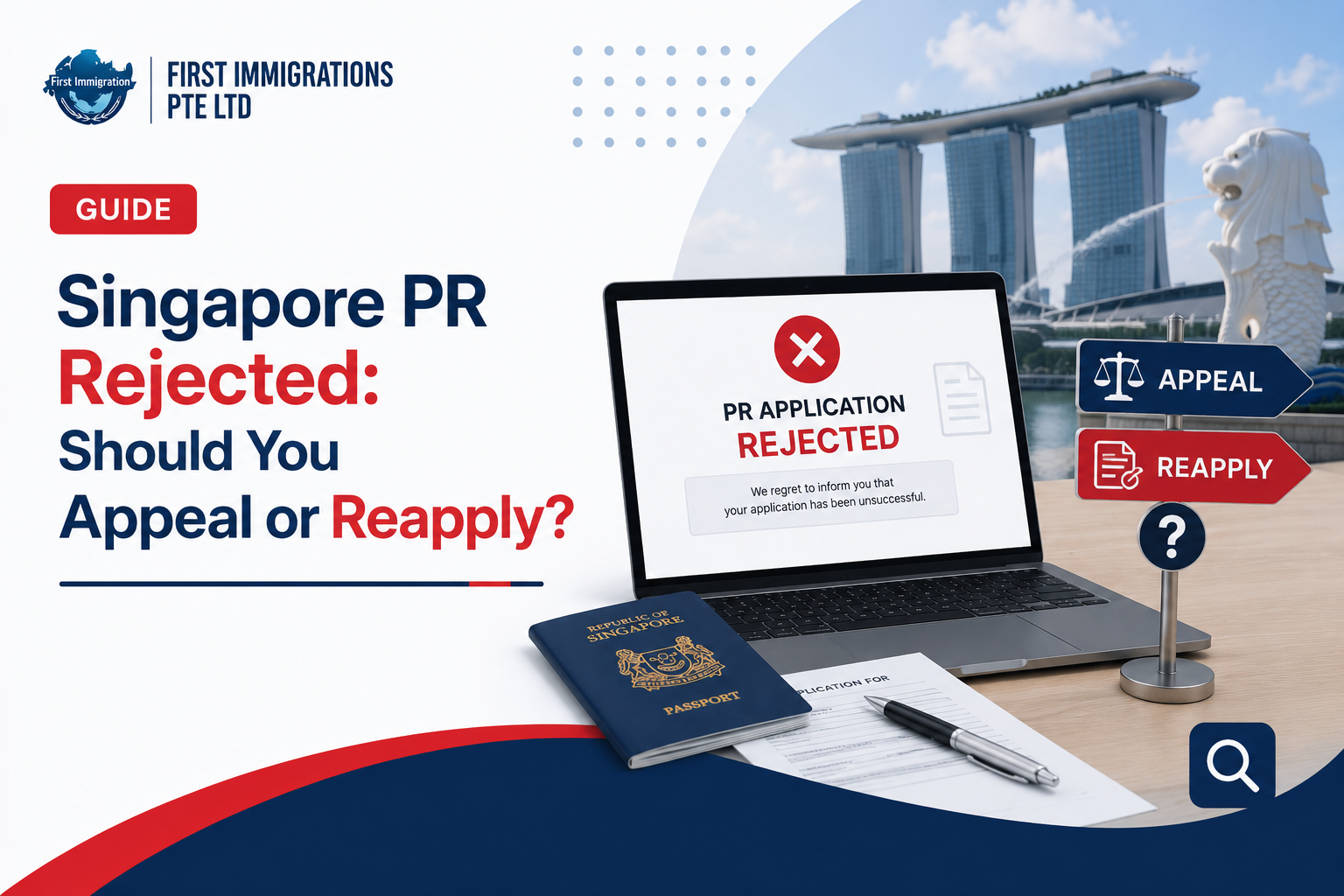
Quick answer: You can appeal a Singapore PR rejection within 6 months of the rejection date, and you get only one appeal per rejected application. Submit it early (ideally within the first few weeks) through ICA’s e-Service, email, or by hand at the ICA Building. An appeal only works when you can show genuinely new, substantive information that ICA did not have the first time. If nothing material has changed, reapply later instead.
First, understand your PR rejection
ICA rejection letters are deliberately short. They rarely state a reason, usually just: “After careful consideration of all relevant factors, your application has been unsuccessful.”
That silence is the hard part. ICA does not publish rejection reasons, so you have to work out the likely weakness yourself before you decide what to do next.
Some context helps set expectations. ICA processes roughly 100,000 PR applications a year and approves around 32,000 of them. Approval is competitive, and a rejection often reflects a profile that was not yet competitive enough at the time of assessment, not a permanent “no”.
Before doing anything, pull up your original submission and read it critically. Our guide on checking your PR application status and the ICA evaluation criteria will help you see your file the way an assessor does.

Common reasons PR applications get rejected
You will not be told which of these applied to you, but most rejections trace back to one or more of the following.
| Reason | What ICA is likely seeing |
| Short time in Singapore | Applying within 1 to 2 years of arriving, before a real track record exists |
| Income below the benchmark | Salary under the median for your age and industry, even if your pass criteria are met |
| Weak family ties | No spouse, child, or close family who is Singaporean or a PR |
| Thin integration evidence | Tax paying but little sign of “sinking roots” (community roles, local schooling, property) |
| Employment or sector signals | Unstable job history, or a role in a less-favoured sector |
| Document gaps or inconsistencies | Unsigned forms, missing tax records, or details that clash with ICA’s own data |
| Overall profile not yet competitive | Each factor is borderline and, together, the case does not stand out |
Understanding the likely cause is the foundation of a good appeal. If you cannot name a plausible reason, that is a strong sign you should strengthen the profile and reapply rather than appeal.
Appeal or reapply? Choose before you write a word
This is the single most important decision, and it depends entirely on whether something material has changed since your rejection.
| Appeal | Reapply | |
| Best when | You have new, substantive information ICA did not have before | Your profile has not changed much since the rejection |
| Timing | Within 6 months of the rejection letter | After a wait, usually 12 to 24 months to rebuild |
| What it is | A request to reconsider the same application | A fresh application assessed from scratch |
| Attempts | One appeal only, per rejection | You can reapply again in future |
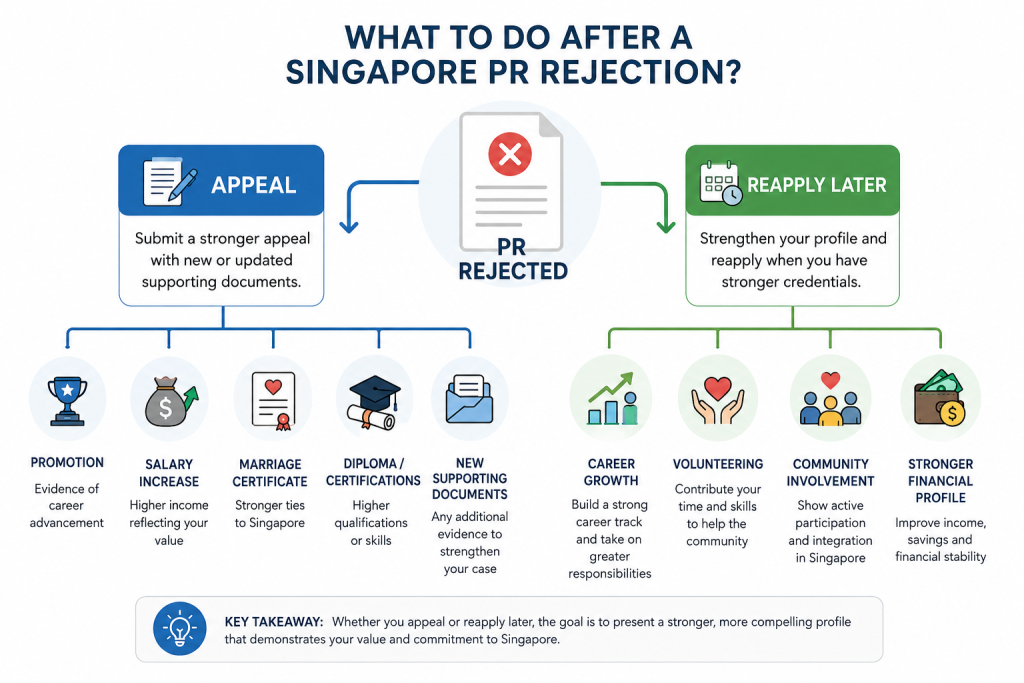
| Strongest triggers | Promotion with 30%+ pay rise, marriage to a Singaporean or PR, birth of a Singaporean child, a new qualification, or a documentary error | Career, salary, or integration still being built up |
Appeal if you can point to a concrete change: a significant promotion and salary jump, a change in family circumstances, a completed advanced degree, or a genuine error in the original file.
Reapply if little has changed. Sending an appeal with the same profile and the same documents usually produces the same result, because ICA already assessed that information.
For a fuller view of what makes a strong file, see our PR application tips and the complete guide to applying for PR.
How to appeal for a PR rejection: step by step
If an appeal is the right call, here is the process from start to submission.
- Read the rejection letter carefully. Note the date and your case reference number. The 6-month clock starts from this date.
- Identify what has changed. Pin down the one or two material developments since your application that address the likely rejection reason.
- Gather your evidence. Collect documents that prove those changes (see the table below).
- Write a focused appeal letter. Keep it to one to one-and-a-half pages and centre it on what is new (details in the next section).
- Submit it through the right channel. Use ICA’s e-Service or the email address on your rejection letter, or hand-deliver it to the ICA Building at 10 Kallang Road. Keep proof of submission.
- Wait. Processing typically takes 4 to 6 months, and sometimes longer. ICA will not send status updates and will only contact you if it needs more information.
Deadline reality check: 6 months is the hard limit, but earlier is better. Submitting within the first few weeks signals that you have a genuine, ready update rather than a last-minute attempt.
How to write a PR appeal letter that gets read
The appeal letter does one job: answer the question “Why should ICA change its decision?” Everything in it should serve that question.
Keep it tight. One to one-and-a-half pages, professional tone, a clean font (Arial or Calibri, 11 to 12pt), and no spelling errors. A careless letter signals a careless applicant.
A workable structure:
- Header: Your name, application reference, contact details, and the date.
- Opening: Reference the rejection date and case number, and state that you are appealing because your circumstances have materially changed.
- Body: Cover two or three concrete improvements, each with specifics and numbers. For example, “promoted to Senior Manager in March 2026, with salary rising from S Y, a 35% increase.”
- Close: A short, sincere request for reconsideration.
What to include:
- Specific figures, dates, and percentages (a “30% pay rise” beats “a better salary”).
- The exact change that answers the likely rejection reason.
- Evidence you already held but did not present well the first time, if relevant. Frame it as, “on review, I did not adequately highlight…”
What to avoid:
- A generic template with your details dropped in. ICA reads many of these, and they read as insincere.
- Emotional appeals about how much you love Singapore, or lists of friendships. These do not move the decision.
- Any wording that questions ICA’s fairness or competence. Arguing almost always fails.
- Padding beyond 1.5 pages. Every sentence should advance your case.
Supporting documents to include
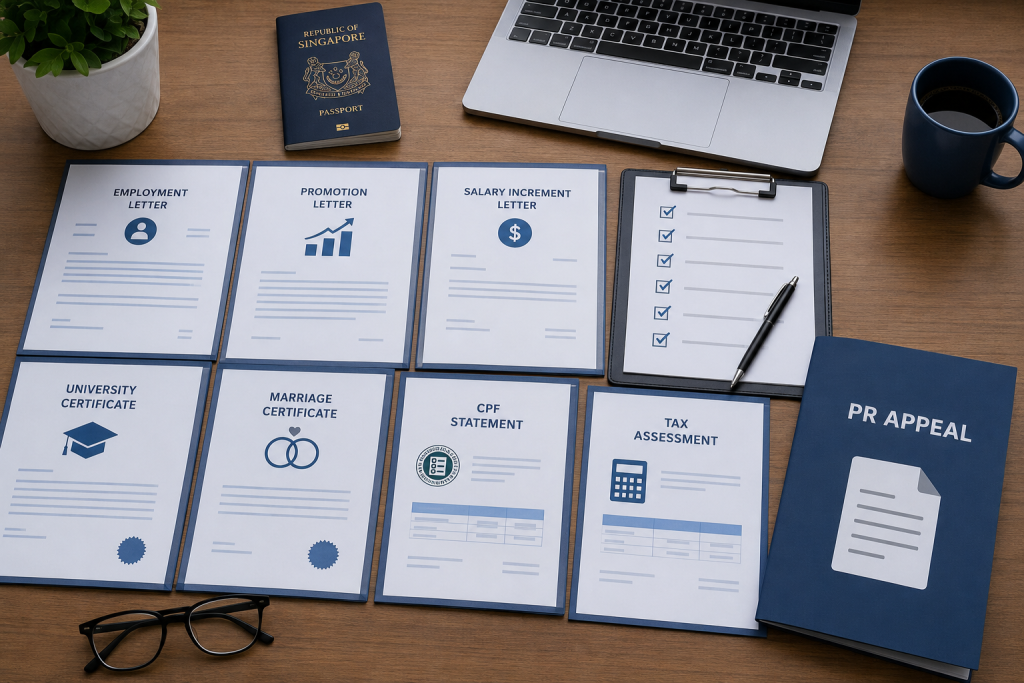
Attach evidence that proves each claim in your letter. Match the documents to your appeal ground.
| Appeal ground | Documents to attach |
| Always include | Copy of the rejection letter; recent employment letter; latest 3 to 6 months of payslips |
| Career advancement | Promotion letter, updated job scope, salary revision letter, performance reviews |
| New qualification | Degree or certificate, transcripts, professional licence |
| Family change | Marriage certificate, child’s birth certificate, spouse’s NRIC or PR details |
| Integration | Property deed or tenancy, children’s school enrolment, community or volunteer letters |
| Financial stability | Bank statements, CPF statement, tax Notice of Assessment |
Number your attachments, list them on a cover sheet, and label each page with your name and passport number so nothing gets separated from your file.
Timelines and realistic success rates
Set your expectations before you submit.
| What | Typical range |
| Appeal deadline | Within 6 months of the rejection date (hard limit) |
| Best time to submit | Within the first few weeks |
| Processing time | 4 to 6 months, sometimes longer |
| Status updates | None, unless ICA requests more information |
| Reapplication wait | 6 months minimum, 12 to 24 months in practice |
ICA does not publish appeal success rates. Industry estimates put successful appeals in a minority of cases, which is why a weak or unchanged appeal is often a wasted single shot. Appeals with substantial new evidence (a major promotion, a 30%+ salary rise, marriage to a Singaporean or PR, a newborn) stand a much better chance than those relying on the same profile.
Mistakes that sink an appeal
- Appealing with nothing new. The most common error. Same profile, same outcome.
- Not addressing the likely rejection reason. If income was the issue, lead with income.
- Using a copy-paste template. It reads as generic and undermines a genuine case.
- An emotional or accusatory tone. Sincere and factual wins; arguing loses.
- Missing the 6-month deadline. Once it passes, your only route is a fresh application.
- Resubmitting the original documents unchanged. Show what is different now.
- Sloppy presentation. Typos and formatting errors signal you did not take it seriously.
If reapplying is the smarter move: a 12-month roadmap
When your profile has not changed enough to justify an appeal, use the wait to build a genuinely stronger case. A practical plan looks like this.
| Phase | Focus |
| Months 1 to 3 | Honest self-diagnosis: identify your weakest factors from the list above |
| Months 3 to 6 | Career: aim for a promotion, salary increase, or a role in a stronger sector |
| Months 4 to 8 | Integration: join community bodies, enrol children locally, build documented ties |
| Months 6 to 10 | Commitment signals: property, longer tenure, deeper roots |
| Months 10 to 12 | Reapply with refreshed documents and a clearly stronger profile |
If your PR route runs through your employment, keeping your pass strong matters too. See our guides on Employment Pass to PR and, for founders and freelancers, how a self-employed EP holder can apply for PR.
When to get professional help
Because ICA never states the real rejection reason, the hardest part is diagnosing your own weak spot and deciding whether to spend your single appeal now or wait and reapply. This is where an experienced consultant earns their keep, especially if:
- You are unsure whether your case is strong enough to appeal.
- Your situation is complex (self-employed, non-standard employment, or multiple weak factors).
- You want an outside read on your strongest angle before you commit your one appeal.
How First Immigration can help
First Immigration reviews your rejected file, assesses whether to appeal or reapply, identifies the strongest angle, and helps you present it properly:
- A frank assessment of your profile and realistic odds.
- Spotting the evidence gaps that likely caused the rejection.
- Framing your appeal or rebuilding your case for a stronger reapplication.
- Guidance across Employment Pass to PR, Singapore Citizenship, and related routes.
Speak to our consultants through the contact page to plan your next step after a PR rejection.
Frequently asked questions
How do I appeal a Singapore PR rejection?
Write a short, focused appeal letter explaining what has genuinely changed since your application, attach supporting evidence, and submit it within 6 months of the rejection through ICA’s e-Service, email, or by hand at the ICA Building. You get only one appeal per rejected application.
How long do I have to appeal a PR rejection?
Up to 6 months from the date on your rejection letter. Submitting earlier, within the first few weeks, is generally better.
How many times can I appeal a PR rejection?
Only once per rejected application. If the appeal fails, your next route is a fresh application after a waiting period.
Should I appeal or reapply after a PR rejection?
Appeal only if you have new, substantive information ICA did not have before, such as a major promotion, a large pay rise, or a change in family circumstances. If little has changed, reapply later with a stronger profile.
How long does a PR appeal take?
Usually 4 to 6 months, and sometimes longer. ICA does not provide status updates during this time.
What are the chances of a successful PR appeal?
ICA publishes no official figures, and successful appeals are a minority. Appeals backed by significant new evidence have a much better chance than those relying on the same profile.
Why was my Singapore PR application rejected?
ICA does not give reasons. Common factors include short time in Singapore, income below the benchmark, weak family ties, limited integration evidence, or inconsistencies in the documents.
Can I keep working in Singapore while my PR appeal is being processed?
Yes, as long as you hold a valid work pass. An appeal does not affect your existing pass.
Is there a fee to appeal a PR rejection?
ICA does not charge a fee for the appeal itself. Any cost would be for professional help if you choose to engage a consultant.
How long must I wait to reapply for PR after a rejection?
At least 6 months, though in practice 12 to 24 months is often better so you can materially strengthen your profile before trying again.