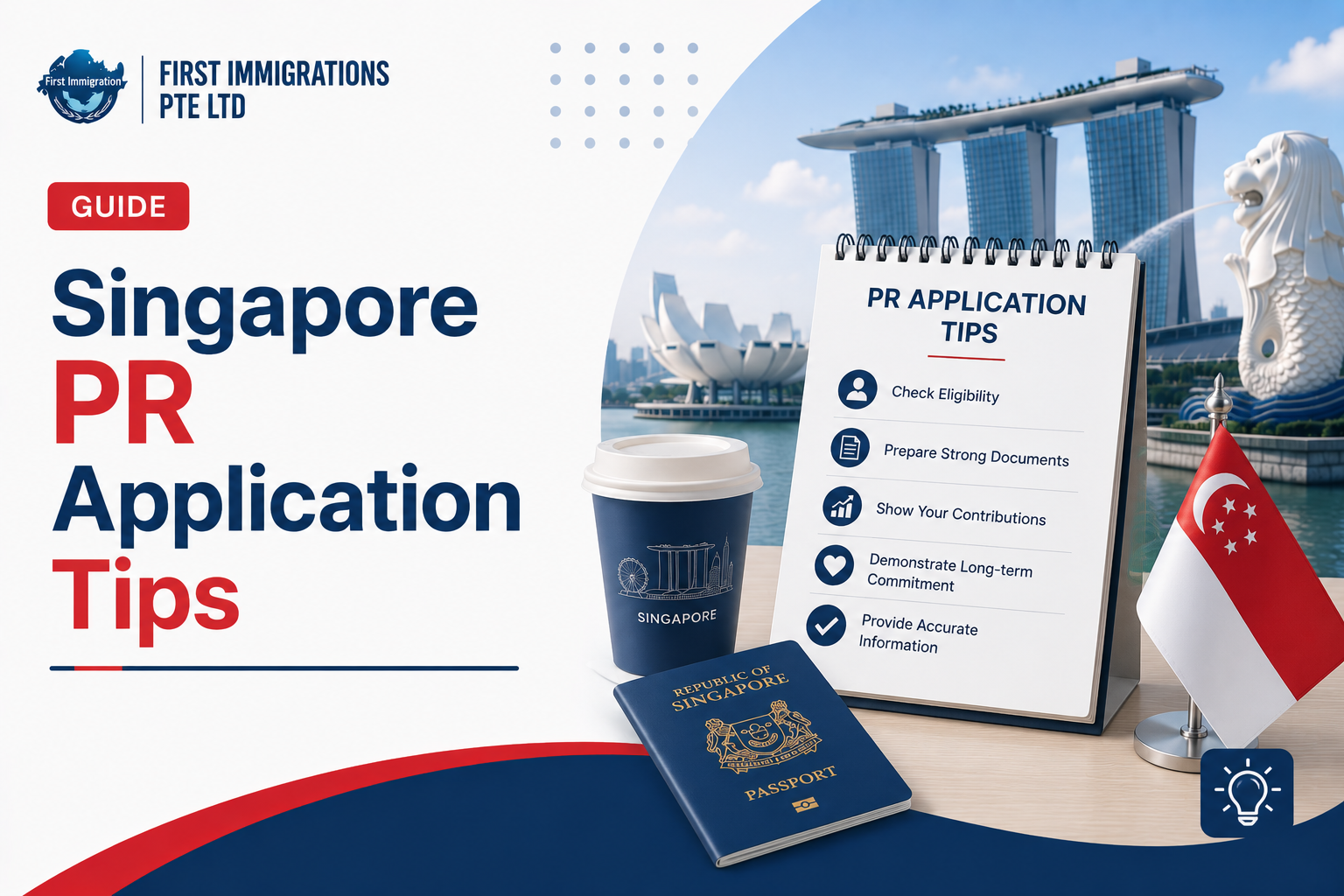
Singapore PR is competitive, and ICA never tells you why an application succeeds or fails. What you can do is control the factors it weighs and present them as one strong, consistent case. These are the tips that genuinely move the needle, from timing and career progression to integration, documents, and your cover letter.
Quick answer: The strongest PR applications combine a stable, progressing career, a solid tax record (aim for 2 to 3 years), genuine and documented integration, spotless matching documents, and a clear cover letter built around past contribution, present integration, and future commitment. Time your submission for shortly after a promotion or raise, and do not reapply in a rush if rejected.
A quick note on 2026 timing
The backdrop is favourable. Singapore has signalled a higher PR intake (recent reporting points to around 40,000 a year, up from roughly 35,000) to counter low birth rates and an ageing population, and PR approvals have been running at multi-year highs. That does not mean approval is easy. ICA still assesses holistically, so a stronger intake rewards well-prepared profiles, not weak ones. The tips below are how you become one of the well-prepared.
The tips at a glance
| # | Tip | Why it matters |
| 1 | Show a stable, progressing career | ICA wants an “up-and-comer”, not a flat profile |
| 2 | Time your application well | A track record plus recent progress reads strongest |
| 3 | Align your skills with growth sectors | Relevance to Singapore’s 2026 priorities adds weight |
| 4 | Prove genuine, long-term integration | Documented roots beat one-off gestures |
| 5 | Include family strategically | Signals stability and permanence |
| 6 | Get your documents right | Consistency and quality build credibility |
| 7 | Write a strong cover letter | Ties your whole profile into one narrative |
| 8 | Consider recommendation letters | Third-party proof of character and contribution |
| 9 | Do not reapply too fast | Rushed reapplications rarely change the outcome |
1. Build a stable, progressing career
Employment stability is one of the first things ICA reads. Frequent job-hopping or gaps weaken a profile; a steady role with a reputable employer strengthens it.
Progression matters just as much as stability. A salary that has stayed flat for years can be a quiet red flag, because ICA looks for someone whose value is rising. Promotions, raises, added responsibilities, and new certifications all show your employer values you and you are growing. If you recently completed a professional course in a high-demand field, put it in.
2. Time your application well
Timing is one of the biggest levers you control.
- Build a tax record. Two to three years of consistent tax filings shows you are a reliable contributor. There is no fixed minimum, but applying within a year of arriving usually looks premature.
- Settle into a new job first. If you have just changed employers, waiting around 12 months in the new role before applying reads as more stable.
- Apply after good news. Submitting shortly after a documented promotion or salary increase lets you present real, recent momentum.
3. Align your skills with Singapore’s growth sectors
ICA rewards contribution that matches where Singapore is heading. For 2026, that means fields like artificial intelligence, green energy, biomedical sciences, and digital finance. If your work sits in or near these areas, make the link explicit. If it does not, upskilling through Singapore-based courses in an in-demand skill shows you are actively adding value to the local workforce.
4. Prove genuine, long-term integration
Integration is judged by depth and consistency, not a single event. A one-off volunteering day does little; several years of steady involvement with a charity, a neighbourhood group, or People’s Association activities is real evidence you have built a life here.
Document it. Keep letters, records, and photos of sustained participation. Children in local schools, long-term community roles, and local ties all count. Pure tax-paying residence with no sign of integration reads as transactional.
5. Include family members strategically
If you are married or have children, applying together generally presents a stronger, more settled picture than applying alone. It signals that your whole life is anchored in Singapore, which speaks directly to the long-term commitment ICA looks for. Family ties to existing Singaporeans or PRs strengthen the case further.
6. Get your documents right
Documentation quality quietly makes or breaks borderline cases.
- Be consistent. Names, dates, job titles, and salary must match exactly across every document and your forms. Contradictions raise doubts across the whole file.
- Scan well. Provide clear, high-resolution, full-colour scans of originals.
- Translate properly. Any non-English document needs an official, notarised English translation.
- Be complete. Missing documents are a common, avoidable reason applications stall.
For the full list, see our guide to applying for Singapore PR and the ICA evaluation factors.
7. Write a strong cover letter
The cover letter is where you turn a stack of documents into a story. The most effective ones follow a simple arc:
Past contribution → Present integration → Future commitment.
- Past: your career, achievements, and economic contribution, tied to skills Singapore values.
- Present: how you have settled in, your community involvement, and your family here.
- Future: your genuine intention to make Singapore your long-term home.
Keep it clear and specific, usually somewhere around 1,200 to 2,000 words. Do not lean on salary alone to carry the letter; income is context, not the whole argument. And avoid a generic letter that could describe anyone. Show you understand what Singapore is looking for.
8. Consider recommendation letters
Optional but useful, a strong recommendation letter from an employer or a Singaporean who knows you adds credible third-party proof of your character and contribution. Two or three specific letters can help tip a borderline case. Our guide on the recommendation letter for a PR application includes samples.
9. Do not reapply too fast
If you are rejected, resist the urge to resubmit immediately with the same profile. The same information usually produces the same result. Wait, strengthen the weak areas (career, salary, integration), and reapply with a genuinely stronger case. Our guide on what to do after a PR rejection covers whether to appeal or reapply.
Common mistakes to avoid
| Mistake | Why it hurts |
| Applying too early | Little tax record or track record for ICA to assess |
| Inconsistent details across documents | Undermines credibility of the whole file |
| Incomplete or low-quality documents | Stalls the application and signals carelessness |
| A flat salary with no progression | Reads as a stalled career |
| One-off or undocumented “integration” | Looks like box-ticking, not genuine roots |
| A generic cover letter | Fails to show you understand what Singapore needs |
| Rushing to reapply after a rejection | Same profile, same outcome |
How long does a PR application take?
Most PR applications take around six to twelve months end to end, depending on how complex your profile is, the quality of your documents, and ICA’s caseload. You can follow the outcome through our note on checking your PR application status.
How First Immigration can help
Because ICA gives no feedback, the value of an experienced eye is in spotting the weak spots you cannot see and framing your strengths well. First Immigration helps you:
- Assess whether your profile is ready, or worth strengthening first.
- Time your application around your career and tax record.
- Structure your documents and cover letter into one persuasive case.
- Plan next steps if a past application was unsuccessful.
Whether you are moving from Employment Pass to PR or applying as a self-employed business owner, speak to our consultants through the contact page.
Frequently asked questions
How can I improve my chances of getting Singapore PR?
Show a stable, progressing career, build a two to three year tax record, integrate genuinely and document it, keep your paperwork consistent and complete, and write a clear cover letter covering your past contribution, present integration, and future commitment.
How long should I wait before applying for PR?
There is no fixed minimum, but two to three years of stable work and tax history is a common benchmark. If you recently changed jobs, waiting about 12 months in the new role helps.
When is the best time to apply for PR?
Shortly after a documented promotion or salary increase, so you can present real, recent progress alongside a solid track record.
Does a higher salary guarantee PR approval?
No. Salary is important but assessed alongside your industry, tax contribution, integration, family ties, and more. ICA weighs everything together.
How important is social integration for PR?
Very. ICA looks for genuine, sustained involvement in the community over time, not one-off activities. Keep documented proof.
Should I include a cover letter with my PR application?
Yes. A well-structured cover letter ties your whole profile into one narrative and is one of the few places you control the story. Aim for clear, specific content around 1,200 to 2,000 words.
What are the most common reasons PR applications fail?
Applying too early, inconsistent or incomplete documents, a stalled career, weak or undocumented integration, and a generic cover letter.
How long does a Singapore PR application take?
Usually six to twelve months, depending on your profile, your documents, and ICA’s caseload.
What should I do if my PR application is rejected?
Do not rush to reapply with the same profile. Identify and strengthen the weak areas, then decide whether to appeal or reapply. Our rejection guide explains both routes.